
Sargam Notation Library
informal music training : Tips & Tricks 13

Do not stop experimenting – A case study
September 8, 2015
WHILE PRODUCING SARGAM/NOTATIONS DO NOT STOP EXPERIMENTINGThere are two versions of a song called "Har kisiko nahi milta, yaha pyar zindagi me". One from a movie called "Jaabaaz" (1980) and other from a movie called "Boss" (2013). This is one of my favourite songs, and the only song till now which I love to hear…Do not stop experimenting – A case study
Effective Ear Training Techniques Unveiled: Practical Tips and Perspectives
September 3, 2024
Today, in our Whatsapp group, we had a discussion on the question put up by Ravi Shankar from Bangalore that"I have a basic question regarding ear training. If we play Sa or any note on different scales of bansuri, obviously it will sound different in different scales as the frequencies will be different. Then how…Effective Ear Training Techniques Unveiled: Practical Tips and PerspectivesFrequenty Asked Questions on Bansuri?
January 15, 2015
As a beginner, which Bansuri I should purchase?As a beginner, you should go for a medium size bansuri (12 – 15 inches long) of scale C or G, as these are neither too big nor too small. Many beginners give up on Bansuri when they do not succeed in making sounds on Bansuri. But, with…Frequenty Asked Questions on Bansuri?How do I find out my Flute’s scale?
January 2, 2017
How to find out the scale of Flute?It is a very common dilemma of many who are new to Flutes. Picking up a flute is easy, blowing it correctly to get the right sweet tone is a bit challenging, but then, playing your flute in sync with a particular scale is the most daunting task…How do I find out my Flute’s scale?How to make Alankars
November 24, 2022
For beginners, it is a common dilemma as to what to play and how to play Alankars (ornamentations)? So, whether we have to play only a set group of notes? Or, we can create / make our own Alankars for practice? For this, the answer is:It is all about logical sequencing of notes. Which means,…How to make Alankars
How to play Bansuri (Bamboo Flute)
March 25, 2020
STEP 1:Buy a Bansuri (Bamboo Flute) of medium size - preferably C or G Scale to begin with. STEP 2:If you can produce a sound from Bansuri, good. If not, then keep it aside and pick up a Pen Cap. Place the open part on your lower lip. Blow air into it. Keep doing it until…How to play Bansuri (Bamboo Flute)How to produce SARGAM or notations of a song?
February 23, 2016
I have been asked by many that "How to produce SARGAM or notations of a song?"Well, I will be answering this question purely based on my own experience of "trial and errors". Since I am not a trained musician, I may be technically wrong while letting you know how do I produce SARGAMs, but the…How to produce SARGAM or notations of a song?How to read Indian notations
November 19, 2014
The SARGAM (Indian notations) posted in this website are arranged in the following manner. Readers can take a clue from it and decipher the notations. The following is how generally the Indian notations are written, but it is not the thumbrule. You may find notations written in other style at other places. But, for this…How to read Indian notationsIndian Sargam Vs Western Notes
January 11, 2015
Following chart may come handy while translating western notes of any tune or song into Indian Sargam, and vice-versa. Scale C D E F G A B Indian Sa Re Ga Ma Pa Dha Ni Western Do Re Mi Fa So La Ti The letters in all the above rows (column wise) generally follow a sequence. For…Indian Sargam Vs Western NotesPlaying Bansuri is like Typing
December 31, 2014
@Darshan Gupta has asked a question, which I myself used to wonder sometime back. I'm sure there will be many of you with this same or similar query:"Sir actually m confused that which notes m playing on bansuri.. those are correct or not...For example... if m playing swar dha thn how I get to knw…Playing Bansuri is like TypingSongs that contain Sargam in lyrics
March 7, 2022
It is a good idea, for beginners and amateur flute players, to practice songs which already have Sargam in them, like, this Asha Bhonsle Song - "Piya Bawari..." which has Sargam inside its lyrics. Why? Because you can play such songs on any flute without actually worrying about the 'scale.' And then once you have developed…Songs that contain Sargam in lyricsThere is only one Tivra swar
December 30, 2014
Many people, especially those who have just picked up learning flute, have a doubt that blowing harder on flute might produce Tivra sound for any note. This is not correct. Blowing harder produces sound of that note on its Higher pitch. For example, if you play "kora kagaz tha", which is a duet song, you can…There is only one Tivra swarWhy the 5th hole on Bansuri is bigger than others?
August 10, 2021
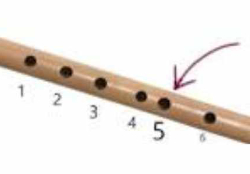
The other day, on our Whatsapp group, we had an enlightening discussion on the question put up by Milind Bhagwat that why the 'Dha' hole on all Bansuri is bigger in diameter than other holes?This question coincidentally generated another question as whether the 5th hole is a 'Dha' or a 'Ni' hole? Here is the…Why the 5th hole on Bansuri is bigger than others?


Segments
SingersMusic DirectorsLyricistsLanguagesRaag Based Songs
- CAPITAL LETTERS = Shuddh Swars (Natural Notes)
- small letters = Komal Swars (Flat Notes)
- M with # [hash] or ^ [exponent] = Tivra Madhyam (M# / M^)
- Letter/Alphabet ONLY = Medium Pitch/Normal blow on flute
- Letter/Alphabet PRECEDED BY a ” . ” [full stop] or a ” , ” [comma] = Low Octave Note/Softer blow on flute
- Letter/Alphabet FOLLOWED BY a ‘ [single quote] = High Octave Note/harder blow on flute
- Notes in { } = “murki” have to be played very fast without any pause
- A Note in ( ) = “kann swar” has to be just touched before moving on to the next note
- A “~” between two Notes = “meend”. That is, you have to glide from one note to another slowly to produce that wavy effect.
- Few “….” (dots) after a note = Play and hold that note
ADVERTISEMENTS
1,437 comments
Chandrashekhar V
I will love it if I get notes of the prelude and interludes, especially because it has a lot of Santoor in it, thanks to Great Ulhas Bapat ji 🙂
suresh sood
सरगम के साथ साथ धुन बांसुरी पर बजा कर भी डाला करो श्रीमान
समझना आसान हो जाता है।
Raj
Its realy realy helpful to all indian flutist. Plz post the notes for the song — BUKU HOOM HOOM KARE by Dr. Bhupen Hazarika. Plz sir. Thanks a lot
Shubham
it is very difficult to get notations by just reading it… It will be very helpful if you put an audio of the tunes played on your flute.. Thank You for the notations..
Suresh Sood
Pl also provide music piece of this lovely song.
रु रु रुरु रुरु रु रु हे
बोलो न क्यों यह चाँद सितारे
abhay nashikkar
plese send full song notetion
Abhay V. Purav
really your site is so helpful for new comers. I myself have started to learn flute on my own by using internet and seeing some Yutube videos since last 6 months on my own . I have no guru as i cannot afford their fees. I am trying to learn raga shivranjini. Can you help me. Also let me know your contact details whether you are from mumbai.
kundan
needs notes of full song
Namritha Lakshmi
HOW ABOUT FOR KEYBOARD PLEASE
keyur
VERY GOOD WORK FOR NEW LEARNERS
KEEP IT UP DATED MORE AND MORE THANK YOU
Nivi Keshri
whats in the bracket?
N(D)S N ND ND like (D)
notesandsargam
Notes in brackets indicate that those notes just have to be touched and let go.
Arghya Majumdar
Hello..first of all let me thank you for publishing the notations of songs ,jingles etc in Indian notations as it is very hard to find otherwise and I am extremely grateful to you for it..
I have certain questions and I will be extremely grateful if you can help me out:
Firstly I play the sitar and am trying to do a cover of this song..but the representations of notes of higher octaves and lower octaves are different here from what I learnt..moreover what is meant by notes in {} and ()? For example {DP} and (RGR)..what do they signify?and what does ‘~’ signify?does it mean that the note played is to be made to persist for sometime?
I will be extremely grateful if you can clear my doubts..thank You in advance 🙂
notesandsargam
http://notesandsargam.com/2014/11/19/how-to-read-notations/
notesandsargam
Please go through the following post to under special characters used in the Sargam (notations).
http://notesandsargam.com/2014/11/19/how-to-read-notations/
Amal Bakali
I am beginner flute player. I love to play tune. When i listen any songs, I think in mind why not try to play this tune on flute. Thank you very much to let us know the tricks. This is really very useful.
Prashant
There is a flute piece after the mukhda. Please add the notes for that too..
Thanks !
ashik
Nice thank u sir
Shreya
this is my favorite site, thanks a lot for your posts, they are really very helpful….
vikram
Bhai Film Loafer nahi Blackmail film ka song hai pal pal dil ke pass.
aur ek baat jo songs ke word hai thik uske nuche hi notation dedo
its very nice and best website than other all the best
notesandsargam
Thanks Vikram for pointing out the mistake. It is corrected now.
pawan
suhani chandni raate hume sone nahi deti flute notes send karo plz
Ami prince
How to play the .p.p.p.p or any notation of same types?
notesandsargam
A dot (.) before a note means that the note has to be played at one octave lower than normal. In other words, you have to blow a little softer into your flute than normal to play a lower octave. Similarly, an apostrophe (‘) after a note means that the note has to be played at one octave higher, which you can achieve by blowing a little sharper into your flute.
Sayan
use your tongue to block the lips for a moment while continuing the blow. this will cause a break and you will get as many of the same note at the same time. or you may use another technique where momentary touch may be done on the lower note which also breaks the note
Ami prince
Can you post the notation of the famous tune played by lord krishna in mahabharat?
sushant verma
Please post Hindi notations of song tujh me rab dikhta hai
bhuvn
since i am very new to the bansuri…help me understand that is this alankar based on any specific mode i.e. kalian or bilaval or it can be done on any mode or scale
notesandsargam
Yes, these are just for practice purpose and can be played without getting into Kalian or Bilaval complications 🙂
gauri Sonavane
This notation can playable on E scale flute?
notesandsargam
Yes. But, you may need to do little improvisations. Good luck.
vikas mourya
sir im just new to flute,,,,,,,,,,
i have a front facing flute……..
im not able to understand your notation,,,,,,
can you help me with the basics on flute like the sa ra ga ma etc,,,,,,,,
Debasmita pal
Sir i want full sargam lag ja gale….please help me.
Amar
Very helpful, Thanks.
amit shastri
Hello.. sir … plzzz tell me sir what is means of R1 … i am confuse to play this R1 tell mein (this is a half notes …???)
himanshu v
why this [~] notation is used? what does it indicate?
Notes and Sargam
~ = “meend”, which means you have to slowly glide from one note to the other.
RENU AHUJA
Namaskaar Sir…….
Ek kahaawat hai ….
KALKAAR WO, AHENKAAR SE DOOR HAI JO……..
aap ek sachey kalakaar hain isliye sabkaa maargdarshan kar ke aapney ham baaki kalakaaron me apnaa ek oonchaa sthaan bana liya hai ye sab mai Man se kehti hu sir …….!!!
Mai ek Theatre artist and writer hun…… Bansuri ki apki website dekh kar aaur aapki sachchi bhaawan dekh kar aapko ek hi baat kehte hai ……U are GREAT…dedicating .
two lines for you from my pen……:-
BANSURI DETI SUKH SWANT
SAHAJ BANAAYEN JISEY PRASHAANT…….
Aap jeewan me bahut prasidhi paayen inhee shubkaamnaaon ke saath……
Pranaam .-
Renu Ahuja.
Notes and Sargam
Renu ji,
Mujhe nahi pata ki mai itni prasangsha ke kaabil bhi hu ki nahi, par apka protsaahan mere liye bahut mayne rakhta hai. Dhanyawad.
Notes and Sargam
I’m no Guru. Just a music lover. You can even call be by my name. Thanks for your appreciation. Stay tuned.
Rahul
The notes which are in bracket what does that mean…? Plz tell me I am a beginner….thank u
Notes and Sargam
These notes in brackets have to be played fast together.
shreya panchal.
These notes in bracket which fast running togather
Amar
Fantastic, The best site for notations, very good collection of songs, Good help to Music lovers, who love to play and enjoy music.
Raju Shinde
Sir
Pls upload song notation of Jab deep jale aana ….
Bhanu Pratap Singh Rathore
awesome work sir…. really appreciate it
shinderaju123
Sir,
Thank you for such sweet song notation. Please send me JAB DEEP JALE AANA SONG notation.
Ayushi Gupta
what is the meaning of brackets in first line? what is the difference between N and N’ ?
Notes and Sargam
Notes within brackets need to be played fast without any break.
N = Shuddh Ni on normal octave
N’ = Shuddh Ni on higher octave
.N = Shuddh Ni on lower octave
kavita dubey
hello sir…can u plz send me notations for song sathiya ye tune kya kiya….from movie love.
Dinesh
i am the beginner in flute i have been tracking your notes from long time its very much useful for us thanks for the effort. i was wondering if you could guide me how to take S#, D#, N# effectively i found quite difficulties in these
Notes and Sargam
Assuming that you mean ‘Higher Octave’ by “#” sign, these notes S#, D#, N# can be played with blowing a little harder. Consider doing this – blow into the flute as if you would blow to cool down a spoon of hot soup. Try it and if you succeed share your feedback. Good luck!
RAJESH PRIYA
is the notation is similar for saxophone?
mark
Yes, but in Sa re ga ma format.
mansi
sir can you notations for any famous shammi kapoor song…i m learning flute since few months and wanted to play for my moms bday…
Notes and Sargam
Are you looking for any song in particular? Will post it. Please give me some time.
mansi
yeah specially yeh chaand sa roshan chehra..i found out that it is based on kalyani raga in carnatic flute which i use..thnx for taking your time..
Suyash sharma
Yes… Technical hitch-mama india.
First flute intro only
Thanking you
vikas bankar
Wow……
vikas bankar
Wow……very nice saregama mein notes milte hi nahi…thank you.
NC . Mukhopadhyay
Very very nice. Thanks for help
NC Mukhopadhyay
sai
just awsum…..
ijaz
C c f d c c a ka kya matlab hy
Notes and Sargam
Ye western notes hai.
Notes and Sargam
These are Western notes
ijaz
Thnx alot but if u a give a little video tutorial we will glade of u
Nirmal Adatia
P S S S N~N~S S RR G~G~M MRS
its based on SA RE GA MA
Asha Kiran Vedalankar
Sir, Thanks for notations. If possible and at ur convenience please send notations for two songs for Harmonium. (1). Hum Dono Abhi no javo chod kar. (2). Maya. Jare Ud Jare Panchi Asha akvedalankar@gmail.com Sent from my iPad
>
Tushar D K
God Bless you.I have been hearing since childhood “No one is Perfect”.But, “Your site is Perrrrrrfect”!
Raman Prasad
Many people who love music may not be trained. Those who would like to practice without going to a teacher will benefit from your contribution. I am one such person. Thank you.
Tarun soni Fiji islands
Good but what is the easy way to produce a sargam tune in vocal harmonium
vidisha
Dear Tarun Soni ji, I think whether it is a flute or a harmonium, or any other instrument, the basic theory remains the same while producing notes.
sujit khade
Dear sir will you please send me a flute note of marathi song natrang ubha.
Notes and Sargam
send me the video link of this song. Let me try.
Ganesha Hatwar
wonderful ! inspire others to do so as your way of experiment
Nayan Jain
I want to thank you for giving us great knowledge about the flute and i enjoy playing the flute notes given by you, it would be very great if sir can you add an mp3 file playing the same notes you had written so that we could have a better understandings of beats and rhythm of the same tune/song.
CEEPEE
PLZ CAN U EMAIL ME THE THAAT AND THE RAAG OF THIS SONG. OR CAN ANYONE ELSE PUT IT OVER THIS PAGE OR EMAIL ME.
THANKS A LOT.
I WILL WAIT FOR THE REPLY.
Akshay Parab
Thank you so much sir …. great work..it really helps me ……. we really appreciate your efforts ……
Shailesh Panchal
Thanks for put this notation.. I really appreciate that you became so helpful for those people who really want to learn play flute..
Even I am beginner.. And want to learn tips so that I can improve and learn to play flute in short time asap..
Arnav roy
quite greatt .. 😀 but i cant undrstnd the signs u r using
Notes and Sargam
Answer to your query is here:
http://notesandsargam.com/2014/11/19/how-to-read-notations/
Shailesh Panchal
what is the meaning of “r1” & “r2”?
Is it Lower & Higher tune??
Notes and Sargam
numerics denote octaves, like,
1 = normal
2 = higher
3 = very high
Shailesh Panchal
oh.. okay.. thank you very much..
can you please upload the notations for flute tone which is played in middle of this song..??
lalit
sir, can you please please tell the sargam notation of the song ‘khamoshiyan’. On net western notations are only available.
http://www.hindisongsnotes.in/2015/01/khamoshiyan-title-track-arijit-singh.html
this is the link of the song.
SWAPAN SEN
CAN YOU SEND BENGALI SONG NOTATION
Notes and Sargam
which song? please send the video link. Will try.
SWAPAN SEN
ANY KISHORE SONG
SWAPAN SEN
VERY NICE CAN POST BENGALI NOTATION
SWAPAN SEN
VERY NICE
Nisar
thank u notes and sargam, onek din theke eta khujchilam, thank u…
jay
tera kamal to tu jane muje to sau kamal lagta hao thank uu
Renuka
Thank you so much sir
Notes and Sargam
You are welcome!
Stay tuned. Enjoy!
vijaya
Hello, thank you for the beautiful notations.They are so accurate and easy to play.
Can you give the notation of the song ” Karvatein badalthe rahen saasr raat hum” from the old movie AAP KI KASAM
Notes and Sargam
Thank you for enjoying the notes.
Please give me some time to produce notes for your requested song.
Stay tuned!
Soumen
Mind blowing….. Interlude of this song is awesome. I am an artist, guitar player &violinst. your notations woek fantastic on guitar and violin both. Keep it up.
And one thing more please post other Salil Chowdhury’s song. Its brilliant.
Notes and Sargam
I am humbled for your appreciation, Soumen.
Stay tuned, and enjoy music.
Soumen
Thanks…. There are other so manysites that provids sargams, guitar tabs and etc. But in your website i first found sargam of interlude,alankars and ragas also. Whch i never found in other sites. Its a very good idea, except interlude compositions are seems incomplete. Thank you again….. 🙂 I have a request to you, can you guve the sargam of song “baagh mein kali khili” from song Chand aur sooraj.
Asha Kiran Vedalankar
Dear Sir Thanks for posting. Notations Regularly GOD BLESS YOU Asha Vedalankar
Sent from my iPad
>
Akash
What does this symbol mean
S~D
mark
~ symbol means “meend” that is, you have to slowly glide from one note to the other.
aakash
plzzzzzzzzz upload khamoshiya title song notes
vijaya
Hi
Thanks a lot for all the notations for nice songs.Good work and good service for music lovers.
can u please post the notation for the title song Satyam shivam sundaram sung so beautifully by Lata ji /
It will be of great help for all music lovers.
Thanks
Pravin kotambe
Thanks for superb collection of notation.
Pls add notation of pal pal hai bhaari vipada hai ayi song from ‘Swades’
vijaya
Thank you so much.i was waiting to get the notes for this beautiful song.
Prakhar
Thanks sir.. it is helping me in learning flute.
Mrugesh
Hi, My name mrugesh kanitkar, from Baroda, Gujarat. I am learning harmonica on my own, and your notations are helping me out to learn. Thanks for the beautiful collction
Pankaj Choudhury
Thanks a ton… i’m searching for Jasne-E-bahar flute note and i got a jackpot.. there lots of popular tunes flute notes are available.. that’s awesome… It is very difficult to find flute notes in sargam, again i’m learner and i need flute notes… Keep posting..
Krittika Sengupta
Hi can you please give me the harmonium notation of Tum Hi Ho by Arijit Singh.
Notes and Sargam
Its already there. Please search it in the list of sargam.
sndpssmnt
Sir You have done a lot of good work for novice like us. Thank U for all your efforts. One more request from my side is if you can upload sound clip along with the notes, it will be great for us. SO that we can confirm we are playing right.
Asha
Very Good. Will try keep it up
Shyam
Uf | naa | karenge | lab | see | lenge
R | R | RRRg | R | R | RR
GGR SSR GG SRSS is better for this line
Dineshprabu S
This is very useful. Thank you 🙂
amit shastri
hello. sir plzzz upload (tere jaisa yaar kanha) from movie yaarana i need this song sargam plzz
Shankar
Hi Prashant,
Thanks you so much, you web site is very informative and gave me lot of information which other sites didn’t have.
I am completely new to Flutes, I started practicing for last 1 month by watching and learning from YouTube. Now, after visiting your website I have a confidence that I can learn and play
Thanks you so much
SUDIPTA
I WANT SOME FLUTE PLAYED WITH THEIR NOTATIONS WRITTEN TO UNDERSTAND AND GET THE IDEA OF NOTATIONS.
Notes and Sargam
I do not get time to record videos. I know this website is lacking on this part. But, I’m trying. Let’s see how soon will I be able to upload video tutorials. Until then, please stay tuned and enjoy your music with Notes And Sargam.
D C Ranganatha Rao
Very Nice Sir. I am also trying to learn keyboard and your exposure/experience is a GOOD STEP TOWARDS LEARNING
Ganesh Hatwar
Thanks sir, will you please try on jyothi kalash jalke and adha hai chandrama”? regards Ganesha Hatwar
Kartick Chandra Sarkar
Hi prashant, I salute your effort. This website is helping people like me to learn flute. I have a request to you. Can you please upload flute notations for some bengali folk songs also (like baul, vatiyali, polligeeti). I am very much interested in those songs but could not find much help from the internet. I fear that those traditional songs are going to be lost in time as the newer generation is becoming less and less aware of them. I would really appreciate your help in this matter.
Harold Narain
I like the great help you are doing for all the good people who appreciate your work. Long may you continue to help those like me who need the aspiration to learn music. Many thanks.
Please can I have your e-mail address. Thanks
Notes and Sargam
I’m glad that you are finding this resource helpful. Thanks for appreciating. Stay tuned.
sufiya
This is sung by versatile javed ali not sonu nigam ok please dont give wrong information to people if you don’t know
Notes and Sargam
Thanks for bringing out the error. Correction has been done.
Mahesh s Bather
Forgive the mistake.
Guru ji is a humanbeing too.
Sachin Patwardhan
I am a beginner, I even do not know ABCD (SARGAM) of flute, just simply bought it as I heard someone playing it at Parvati in Pune (Maharashtra) and got interest in playing it, and while searching on google for Notes & how to begin playing I found this site and found it really nice, its really well designed for both beginners as well as regular practicers. Thanks a lot, I will keep visiting this site now on wards. THANKS ONCE AGAIN.
Chandra Prajapati
At which scale it is played? I need it to translate it into Indian Sargam.
Notes and Sargam
Please look carefully it is already in Indian Sargam. I played it on F#
Br
great ! Thanks for sharing this. Your information is very useful for all music lovers. thanks again !
Hari
sundar
ANAND BABU ARUN
EXCELLENT GUIDE FOR BANSURI LEARNERS……
THANKS A LOT…. FOR I HAVE LEARNT TO PLAY SO MANY SONGS VIA BANSURI WITH THESE NOTES…
EXCELLENT JOB… NEED MORE…..
THANK YOU SIR…..
mark
hi
Anonymous
Thank u so much for the notations of Chingari koi bhadke
RAMESH CHAUHAN
Please give me flute music notation of this song
mark
The above is flute notation only. Just try to play on your flute. Enjoy!
Khagendra
What does the sign ≈ symbolize here ? Plz help me sir
mark
~ means you have to slowly glide from one note to the other. This is called “Meend” in Indian Classical terms.
Khagendra
What do ri2 and a2 symbolize? Please sir give me the answer. ..
Ratajowski
found out this site an hour ago. overwhelmed by what i see, its a superb work u are doing sir. just the thing i was looking for, and this site fulfills that need perfectly. Keep up the good work Sir!
Nisha
Is the ‘Ga’, Komal
But I love this site keep it up
Shaunak Saswade
What thaat is this on?Which swars are komal
Shahid ahmad
Sir bazigar oh bazigar song note need there is but its on apiano key board I need in indian sargam
Thanks
SANTANU DAS
Thanks for this totally correct notation.
jeetu
Thank you for sargam Thank you so much
Ashutosh sahu
what is meant by S(r)S
mark
a note in () is called ‘Kaan’ Swar, which you have to barely touch, and not play fully.
Ashutosh sahu
what is S’
mark
‘ means that you have to play that note on higher octave. Here you may call it ‘High Sa’
J.S
What does node in baracket indicates ?
For example = (G) in MG R (G)R S N… 2
2. = (R) in Sg | Rg | R S N | S | S… (R)SN
mark
here is your answer:
http://notesandsargam.com/how-to-read-notations/
prashant sharma
sir I can’t understand the difference between notes of madhyam and taar saptak in this notation … pls help to identify..and also the meaning of nnnn in this ..
mark
Dear Prashant,
You might get answer to your query here:
http://notesandsargam.com/how-to-read-notations/
Good day!
Rahul
nnnn
It is called Komal shuddh swar
Madhya saptak is Notation like S R G
Taar saptak is Notation like S’ R’ G’
rohit parihar
Really v nice
Sushil Gera
Sir, could you tell us about choice of scale of bansuri(how to choose the scale) for a particular song.Kind regards. Sushil
mark
Dear Sushil,
I have written a blog which might answer your query. Here it is:
http://notesandsargam.com/how-to-produce-sargam-or-notations-of-a-song/
Good day!
SWAPAN SEN
SIR,
CAN YOU SEND BENGALI FALK
1-DADA PAYE PARI MELA THEKE BOU ENE DE
2-SADHER LAO BANAILO MORE BAIRAGI
Anitya
It was really helpful and very clear. It also explained how the perfect ear for music play a role in developing even a small piece of music. Playing an instrument takes much more than singing and is an art which one could excel only with concentration and efforts.Thanks Sir.
Jay
Awesome !! I really loved this one and I find this to my relief in times of work stress. Playing this makes me feel so relaxed ! Thank you very much ! 🙂
Piyush Patel
Thank you very much ! Very Helpful notes ! Regards.
İrem
Like kind of do re mi fa notes please. I dont know that. For example it starts like this;
La-mi-mi-fa-mi-re
La-mi-fa-mi-re
La-re-re-mi-re-do
Si-do-re-do-si-la
mark
Hope the following page will have your answer:
http://notesandsargam.com/indian-sargam-vs-western-notes/
Thanks.
Dipak
Pl gibe notes for Hotose choolo tum mera git amar kar do
Vijaya
Hi
I really appreciate the good job being done by you for all the music lovers. Your notations are correct and easily we can play them. I have one humble suggestion. Pl also add which taal will go with the song because these days you get keyboards with the Indian raags and Taals.
Also can u update some of the old post notes where the interludes and introduction music are not included?
Even if you can update one song per week, it will be a great help, especially for those who want to play for small functions. You know it is very difficult for us to do interludes and introduction music on our own.
Thanks.
mark
Thanks for the suggestion, Vijaya.
I will surely look into it.
Stay tuned.
Regards, Prashant
Arun Kulkarni
I am learning keyboard. I find these notes are very useful for me. I am very much thankful for these notes.
Suryakant
What about d octave?
mark
please elaborate your question.
Dr.Gholam Mostofa
Thank you. I appreciate your endeavour and wish the best,
Arun Kulkarni
I m bigginer. These notes r useful for me
Rajendrasinh
Excellent job. Keep it up pl.
himanshu
The smal g wht does it mean?
Can u mail me some soothing sargam
mark
g = komal Ga
G = Shudh Ga
Suryakant Khambekar Khambekar Suryakant @ gmail.com
Pls. Post the notation of d song of “Chhaya” movie. ‘ Itana na muzase tu pyaar badha , k mai ek badal aawara ‘ with music of d song. I shall be very much thankful to u Sir.
mark
here it is:
http://notesandsargam.com/itna-na-mujhase-tu-pyar-badha/
enjoy!
Diksha
Great Work is done by this website for flutist. In last few months website presentation has been improved substantially.
Thanks and Kuddos for the work
Need notes for Oh Re Taal Mile Nadi Ke Jaal min.
channa bhogal
Thank you for the hard work you have done in producing these sargams and continue with this good work.
I love singing gazals and found you have produced sargams for three gazals, tum itna jo muskura rahe ho, yeh dil yeh pagal , and ranjish hi sahi.
Please do more gazals notations if you can find time it will be very useful for people like me and if possible please indicate which raga the gazal has been sang because many of us can not work out which raga the gazal has been sang.
In any case you have done a great job , my best wishes to you.
prashant
Thanks. Very informative for beginners.
Anonymous
can you give me the note of bengali song ‘Amar bhitor o bahire’ https://www.youtube.com/watch?v=1ZaYc9cLwkE
mark
here it is:
http://notesandsargam.com/amar-bhitoro-bahire-ontore-ontore/
enjoy!
Ramakrishna Das
It’s really awesome…. I love notes & sargam
Anonymous
What does ~ mean??
mark
http://notesandsargam.com/how-to-read-notations/
Gagan Sharma
Hi Sir,,,
I just wanted to know that all these sargam are also suitable for Harmonium? Should i practice them with a harmonium…
mark
Yes you can play these notes on harmonium as well. Though, you may have to do a little improvisation on your own.
Good luck!
N.S.Singh
big thank you for notations of this song.I tried to play song Dil ka khilona hay toot gaya on harmonium but failed.Please provide notations for this song.Also if you do not mind please provide notations for do hanso ka joda bichhad gayo re gajab bhayo rama julam bhayo re.These songs are sung by Lata ji.
nikita
can u translate it to hindi notes also
mark
Dear Nikita,
These are in fact, Hindi notes only. I write S for Sa, R for Re, G for Ga and so on.
Enjoy!
Thanks, Prashant
Anonymous
Hey sir plz tell me the notes of our national anthem on harmonium jana gana mana
mark
here it is:
http://notesandsargam.com/jana-gana-mana-indias-national-anthem/
enjoy
Vishvakumar
You are master of yourself.
Raj kumar mishra
Thanks boss in the same way i am trying to be painist i am also learning at my own.
Naresh Kumar
So nice
Naresh Kumar
Sir thanks for notations
Rojen
Thank u so much for sharing with us
shashi
What is meant by GGG {MGRS}
mark
notes in { } need to be played very fast
Prashant
Sir i wanna CLARINET svarlipi of ‘a mere vatan ke logo’.Svarlipi must be six type of svar(tirv,madhyan,mandra,vikrit{komal},tirv-vikrit,mandra-vikrit).Plz.Very urgent.
mark
here it is:
http://notesandsargam.com/aye-mere-watan-ke-logo/
enjoy!
Mahesh mali
good efort to explain notetion.. nice
prathap
Good sir.please give me this song note koi tho bath hai love song notes for piano
JATIN
U CAN GET NOTE WITH RAGA NAME BESIC
Praveen
Kindly post the notes for more lines of the song
SATVIK LUTHRA
Great work guys! Thank you For The Notes Keep Uploading
Ankit Bhandari
Transition between P and M is difficult.
Any tips.
mark
Keep practicing with alankars GMP PMG as much as you can. let others feel bored of it. but you must keep practicing until your fingers become swift on these notes. You should get it in a week or two. Good luck!
Mohan Das
Sir…i actually very needed another notation of Mahabharat …..in the last it says Krishnaaaaa…
hansraj
Nice rachna and notes vansuri the same time as a result
Anonymous
There is a flute price after the mukhtar .please add those notes too
SWAPAN SEN
CAN YOU SEND, DADA PAYE PARI RE MELA THEKE BAU ENEDE(BENGALI FALK)
FOR THIS MANY MANY THANKS
SWAPAN.
sonu
thanks song ka sargam ke liye kya ham aapse bat kar sakte hain mera number hai 8936880786
Sadhana Ghosh
Thanks a lot.
Jinesh Mehta
Very true. I’ve experienced that while setting up sargam on my own. When i fails to set up some song.. i keep on changing the scale.. and could find some missing notes. Thanks for sharing the experience
deep singh
Chehra hai ya chand khila hai
Dr Deepak kumar Khareliya
Thanxvery much for notes
Subhash Bauri
this is very helf full site tahnk u
ashiq
Very good
sundaram
sir please send rim jhim ke geet sawan gaye gaye bhighi bhighi raato mai for harmonium and one more tum jo chle gye to hogi badi kharabi for harmonium
Sayan Kundu
The notes with point before them are mandra saptak notes???
mark
correct.
Anonymous
Sir what is # meant in this notation
mark
Play Sa on a higher pitch
Sandita Mukherjee
Do you have guitar notations for Purano Shei din er kotha? Pls send it to me. My son wants to practice for an event.
mark
I am not proficient in writing western notes. I can only give notes in Indian Sargam format. Your son can find out first the Sa Re Ga Ma on his guitar and then he will be able to use the notes that I post in this website. Good Luck.
Anonymous
Plz give sargam in Hindi
mark
These are all Hindi Sargams only, written in English alphabets, like S for Sa, R for Re, G for Ga and so on.
Good luck and stay tuned!
prem
What does mean by”….”and”{}” ?
mark
“….” means you have to hold the note for a while
“{ }” means you have to play the notes within these brackets without any pause
Anju
does N stands for hindi na
mark
Yes, it does.
rohan sharma
Nice but i dont think so anyone can play this song
mark
Why not? Just give it a try. You will do it. Good luck!
abhi pal
I can
Anagha
Thank you for notes it works…..
M.P. Hedaoo
please provide notation for do hanso ko joda bichhad gayo re gajab bhayo rama
Tapas pal
Harmonium notes ‘Ruk ja raat……..(Dil ek mandir)
Anonymous
Thanks
sundaram
please send me sargam of ek tera saath hamko do jahan se pyara hai
Wasim
Konsa scala main bajana hain??
Or ye sargam me baja nehi paa raha hu. Plzzzz help me.
mark
F# scale par baja ke dekhe.
parag Gedam
What is # and ~ sign
mark
here it is:
http://notesandsargam.com/how-to-read-notations/
thanks
Satyajay Mandal
You have given it right @mark
Anonymous
thnx sir for guide us…
priyansh jigar
i am confused …..
in komal swar an tivra swar.
mark
here is the answer:
http://notesandsargam.com/there-is-only-one-tivra-swar/
Avijit Bardhan
A very useful one… But can any one help me out with the notation meant by s’
mark
This means you have to play Sa at a higher pitch.
soma shil
its ohk …….l am a harmoniyam platee so this songe is realy ……so good …and also l am a bengali
Anand Raj
Hi , Could you please provide the flute note for the song “Mala mele viri vechu– Maheshinte prathikaaram
“
Pranali Patwardhan
excellent notation of this divine song..thanks a lot
Anonymous
I appreciated your efforts..And thanks for sharing your knowledge…..
Yogesh pawar
बिल्कुल सही कहा अपने
Varun Vijayvergia
awesome
DC Ranganatha Rao
Can I know. The raga of the song ” jyothi Kalashnikov jhalke” sung by lathaji
Bharat
“Jyoti Kalash” is in raag Deskar … 👍👍👍
Anonymous
Sir what is the procedure in the case of tumbi
SAKSHAM
CAN YOU WRITE SANAMTERI KASAM
manika kakran
Best song I have listen in my life
Ameeca
it was easy if it was sa re ga ma type.
i didnt understand anything.
🙁
Yogeshwar
It is still in Sa re ga ma
Deep Gayen
S used for sa, R used for Re, G used for ga
m used for ma(sudh) , P used for pa , D used for dha, N used for ni.
S* used for sa (height octav / tar saptak)
p used for pa ( low octav / madra saptak)
S~N for mind swar S to N
Samprati choudhury
I also want full notations
bhavya
Who to read this notea
Amitabha Majumdar
please give the notetion of Terey Most Most Do Nayen.
Akshay Kanase
Extremely helpful and I am enjoying it
Anonymous
Are baba shor nahee SOR SOR
$HA$HANK
Can u pls make sairat flute music
Darshan Sadhu
Can you please tell original scale of this song?
Arman Ahmed
D
Shivu
D Natural Scale. D-Middle Flute was used in this song.
Debangshu Goswami
D
Harry
Please upload Barso re sargam. And also please tell the raag in which the song is. Thanks for uploading the sargam of such beautiful songs.
Avinash
Dear Friend,
Thank you very much for the song notations of mine many favourite ones which I have been searching for years.
Deepali jain
Pl. Find notations for marathi song ruperi valut
Amitabha Majumdar
Please give the notetion of Humko Hami se churalo .Please Please Sir.I am anxiously waiting. Amitabha
Anonymous
Please add some notations to understand about lower or higher octave. It’s difficult for beginner like me.
Arasan
The real scale for this song is F#.
Sk
It’s Bm
samarth
it is nice
संजय
बहुत अच्छा
R Deo
Thanks Sir for restoring the website. Recently I got interest in playing flute. This website is of immense help. I alao come to know there are many sizes of bansuri. May u please suggest me which size is appropriate to start with?
mark
As a beginner, you must go for a flute which is easy to hold, neither too small nor too big. Ideally a medium size Bansuri (12 – 15 inches long) in Scale C or G would be fine for you. Good Luck!
R Deo
Thanks for guiding
R.G.S.Rathnayaka
Please send me a eastan notation of ‘Tu ganga ki moju me’ (biju baura film) song.
jagdish gupta
What a strange coincidence the most celebrated flautist of our times Pt. Hariprasad Chaurasia began his career as a typist!
SaurAbh
Thank you movie ke notation samaz nhi aa rhe plz hindi me bataya…..n …mahabharat title song also plz….jldi
Suhadini madhu
I have tried it mind blowing music come out in veena instrument thanks
Harmeet Singh
thanks for this I need it v badly
dheeraj
very good, i can perfact play it notation. thankyou
Hiten Sethiya
how to play s#
mark
S# means that you have to play Sa on flute on the higher octave by blowing harder.
Mahesh S Bather
Thank you very much for providing notes for hindi songs.
Kusuma
Can we play these notations on violin
mark
hopefully, Yes.
Sayan Kundu
if your key note on the violin is C then C will be your sa then leave a whole note and get D which will be re. then leave another whole note and getE for ga then leave a half note and get F for ma( since E# does not exist) again leave a whole note and get G for pa another whole note left gives A the dha another whole note left gives B the ni then leave a half note and shift to the higher octave to get a C which gives you the taar Sa.
precisely use the formula of
whole_whole_half_whole_whole_whole_half on higher octave to get the western and eastern conversions. happy bowing
Akash maniya
Sir can u plz provide LAAL ISHQ-ARIJIT plz……i deadly need this song notation
Nidhi
This site is great but it uses very difficult notes I mean to say that plzz upload this song in Hindi it would be great
mark
Dear Nidhi,
These notes are not written in western format. I write S for Sa, R for Re, G for Ga and so on. Hope you will now enjoy playing these notes . Thanks.
A CHOPRA
THANKS, GREAT HELP.
Akhilesh Kumar
plz post the sargams for dil toh hai dil dil ka aitabar kya kijiye song
Gautam
Hello,
Your website has been very helpful for me to learn notes for my keyboard.
Just a quick question as I couldn’t find the answer anywhere on the website, what does a note followed by ” double quotes signify?
Thanks
mark
I think that anything that is written after and on top of a note signifies that the note should be played on its higher octave. Similarly, anything that is written before and at the bottom of a note means that the note has to be played on lower octave.
Mishal
please tell me the name raag name of this song….
akshay j mkstari
nice website i like it and thanx for helping our fluateis friends
Bharat
Ma always sound sharper than other notes. I have tried everything like blowing slowly/gently but no luck. All other swaras/notes sound have more bass. I am using G scale flute.
mark
You need to check whether your flute is in tune. Take help from mobile apps like ‘Swara Meter’. If tuning is the problem, then it is time for your to get a better well-tuned flute.
Good luck!
Farida
What is meant by R gR
mark
This means, that you have to play Suddh Re and then play komal ga followed by Suddh Re.
Mehal
Komalga
jeetendra
What does the scale stands for flute, how to recognize the scale of flute, how effects the scale to the flute. Does the scale changes the sargam ? means if i bought G scale then how G effects the sargarm
mark
Here is the answer to your question:
http://notesandsargam.com/how-do-i-find-out-my-flutes-scale/
David samuel
Hello sir, your page is very very useful. Thank you for the above chart. In the same way could you please provide me with the sa ri ga ma pa da ni sa of all the minor keys Cm, C#m, Dm, D#m, Em, Fm, F#m, Gm, G#m, Am, A#m, Bm and more if any? I searched in the net for more than 2 hours but no avail. Pls help me. Thank you much.
Love David
mark
Dear David,
If you carefully look at the chart, your question has already an answer over there.
Good Luck!
Rakshandaa
Hello
For minor keys I have a doubt too for the conversation.Have been trying to
Figure out from the chart but couldn’t can you please elaborate?
Thank you
Mark "Gee" Smith
hi David
I am hoping you got oriented on the minor scales, but if you didn’t, have a look at “relative keys“ or “relative minor“ on Wikipedia : https://en.m.wikipedia.org/wiki/Relative_key
Relative major and minor keys use the same notes but start in a different place, for example C and A minor, D and B Minor, etc.
Not sure what you want to do that information, but hope it helps…
ermmm
for minor key of C, you just have to substitute C in the major scale for c in the minor, D in the major scale for d in the minor and etc…
Nagendra Singh Rathore
how to read these notations in all three saptak?
mark
Any sign that is written before and at bottom of a note denotes lower saptak, viz. ,S ,R, G etc. And, any sign that is written after and above a note denotes higher saptak, viz. S’ R’ G’ etc.
shikhar singh
sir i want flute notations of har dil jo pyar karega……from tune to whole song can you please do this for me.
shikhar singh
which scale should i choose as abeginer and where i have to go ,to buy a flute in delhi best in quality but slightly low in budget around 1500 hundred please help me sir…..please
shikhar
sir which scale flute ,i should buy as a beginer,where should i go,to buy a flute in delhi having slightly low budget around 1500 please help me sir..
mark
As a beginner you should go for a medium size C or G scale flute. That should not cost you more than 500 rupees. Good luck!
Roshan
Which raga is. “Abhi Mush mein kahin” based on please?
Arman Ahmed
Yaman
JASBIR SINGH
Very interesting. Can we have some notes for some oldies by request. Shall be grateful.
Presently I am interested in SUR NA SAJE KYA GAAOON MAIN (Full song).
Satyajay Mandal
I feel the same also
Mahesh S Bather
Wonderful notatìons of aise na muje tum dekho ………
Thank you sir
Mahesh S Bather.
Rupam kumari
I want to learn how to play notes and Sargam
mark
here you might find your answer:
http://notesandsargam.com/how-to-produce-sargam-or-notations-of-a-song/
DJP
Hi
I am new to learning music & its notation, but I must say the notations you have given has been of immense help to me so much so that I started to play few songs with confidence.
I now request you for sargam of song Woh shaam kutch ajeeb thi. This song is very dear to me.
amit purkait
sir/ MDM ,a,b,c,d,e,g ei sober upor tabs gulo file khub help hoy
mark
here you might find your answer:
http://notesandsargam.com/indian-sargam-vs-western-notes/
Saurav Mukherjee
We want pa ma ga re sa song notation
Nakendra Thapa
how to know the scale of Banshuri? like C,D,E scale . how to know plz suggest me ..
mark
here is your answer:
http://notesandsargam.com/how-do-i-find-out-my-flutes-scale/
Manish
please also attach the ending tune notes of this song 🙂
thanks
sifat
wow ..
Amar
Beautiful Song Sung by OUR Legend Kishore Kumaar ji, in his beautiful voice and well done for the notation in SRGM formate, actually I always love to play and learn in SRGM style of notes, they sound musical. I may be wrong -but to me CDEFG Does not sound musical, sorry if I have hurt your feelings. When ever I see notation in srgm i want to immediately learn to play it…….
uday
Thanks.
Gaurav
Radha he bawri song notion
Amitabha Majumdar
Thank U Gurugi and take my Respected Pronams. – Amitabha Majumdar
Rashmi
How to play D’ | d?
mark
D’ = Higher Pitch, blow harder on flute
d = komal swar, blow normally but by opening only half portion of the last hole of the flute.
Thanks.
Kishan
Dear Sir, pls tell how can we smoothly play ma to pa n vice versa?
Manoj Modi
I’m Manoj Modi, 54.
I picked a flute one year before. I have not even having knowledge of saregamapa
Made many mistakes. Now I can play little good.I am not taking any classes for it.
Perticularly for flute any issues has only one solution
Practice
Practice
Practice only.
I also make flute without any guidance.
Don’t think much, don’t get depressed. Keep on playing. Sometimes don’t care for saregama or its alankara. Keep playing like a kid.
Flute is the most difficult instrument to master. 90% people leave it. So be positive and just keep practicing
Pallab Das
please give me the sargam for AMAR SOKOL DUKHER PRADIP, JELE DIBOS GELE KORBO NIBEDON….. by Rabindra nath tagor…. please please..
Mahesh S Bather
Thank you sir for providing notations for Lambi judai. Since long time i wanted to play this song on flute.
Pavan sharma
Thanks for notifications
Akash
bht bht bht bht ala
but ayk bat smjh ni ai bansuri me is song ko play kesy krna ha
+923138060408
Anita
Sir.. Plz send hamnava song from hmari adhuri khani. .. N there is lot of song which I want but it is unable to find… So plz upload the newly song….
naman jain
There’s something wrong with the line ‘jee chahe jab humko awaz do ‘ ….awaz is not sounding as it should
tushar
vry helpful….tnxx a tonn…
sudipta mullick
you gives alankar on raagas please give us a chance to hear bansuri played on those alankar . we would leran to reckgnize notes by hearing
Unknown
Agree, without Hearing notes are only half useful.
Pavithra
hello can i get violin notes for tum hi ho? i’ll appreciate it
Anil
Main fluet bjana sikh rha hun .
Aap ke notes kam ata hai thank u .
Azalea Inara
I bought some notes from abroad and it was written do re mi fa so la ti do on it i was not able to understand it …now i am …… thanx verry much! i got a lot of help….
AZALEA INARA
Chandan Bhuyan
accurate note ……thank you
Drashti
Hello, what does ” .P ” denotes?
Thanks for the awesome collection.
Good day!
mark
.P = low Pa (softer blow on flute)
Veer
It means komal Pa right?
mark
Pancham (P) is a Shuddh (static) note. It cannot be komal or tivr.
What I meant was to play P on low octave.
Souhardo Dewri
Please try to make a change in this side as we can get any song’s notation in the form of pdf file which we can download easily
Mohit Kumar Saini
I love this song tom hi ho
Amarabati basu
Plzz give the sargam of BHROMOR SONG..
Amar
Thanks. Great help.
Amar
Thanks for the notation, really a great help.
Please carry on with this website, God bless you.
Amar
Thanks again, I am really enjoying reading all your notations, espacially thanks for posting in SARGAM formate, For me it’s easier to read and play on a key board.
manju
Thank you for your help i am learning a lot
vinod
perfect sargam
Ananda Das
i like this notes and sargams website because get almost of the songs notations here and can able to reflect the sargams in the flute
waqar
respected Sir ! I am in need of sargam of following songs of Lata
1- lo a gaee un kee yaad wo nahi aye. 2- kaha ho tum zara awaaz do hum yaad kerte hain. 3- o raat ka musaafir chanda zara bata de. 4- dil tarne waley tujhey dil dhond raha hay
Mahesh s Bather
sir You are doig a really great work by providing notations for songs. God bless you.
Dipak Ghosh
Thanks is a small word which is not sufficient for you. You have given lot of resources who are not professional but enjoy the music like you. Really happy that you love music love people so you are not charging anything. According to me love to anything means done something without any expectations.
Again thanks.
Can you please share aage bhe janena tu songs notation.
TAPAS PAL
I am very pleased to have such a notation website/organisation. Usually I frequently visit your site as per requirement. In addition to this I would like to have the harmonium notes of HINDI song ”YE NAYEN DARE DARE” Singer-Hemanta Mukherjee.
devendra poudyal
im 52 but i like to learn some more.and iappreciate your notes which ive gone through.but some thing sad is no comlete notes.like for the song-ghungru ki taraha-u havent completed this why?
please can u complete this?
i lke to admire u for talent in such a short time.thanks .from Nepal
vidisha
beautiful
Partha
How to play M(P)? Can you please tell me
Abhijit Maity
love you sir, please share some song to play on harmonica no komal note,no murki simple song. please please please
Shirish Halbe
Dear Sir
You are simply great.
Bablu
I dont know play M to P notes
Kamal
Missing notes for jal jal utha hoon main line
Rizwan
Sirji, can you please upload some Urdu songs as well? Here are a few of the popular ones:
1.) Bohot Khubsurat Hai Mera Sanam
2.) Yeh Kagazi Phool Jaise Chehre
3.) Sun Wanjli Di Mitri Tan
4.) Sayoni Mera Mahi
Jains
Guys this is diatonic scale consisting of 2 whole steps followed by 1/2 step then 3 full steps & finally 1/2 step (C-D-E-F-G-A-B-C) notice C to D whole, D to E whole, E to F half step, Fto G whole, G to A whole, A to B whole & B to C half step.
Apply this to any key & you will get ur query answered.
Mallika
Truly helpful site. Song lovers will be very much satisfied with this..
Aniket
Very very thank’s for giving notes.
waqar
Dear !
please provide the sargam of following songs
1- kaha ho tum zara awaaz do hum yaad kerte hain
2- O raat k musaafir chanda zara batado
3- dil tor ne wale tujhe dil dhoond taha hay
4- lo o a a gaee un kee yaad wo nahi aye
Harmeet Singh
Thaaaankuuuuuu so much I need this v much
dilip
nice song and equally perfect notations.
Learner
What does … mean?
KD
means to continue the same set of notes on repeat
Lakshita
Thanks for the notes they made my day
Aslsm
A very useful effort for
beginners
Mark "Gee" Smith
Can you lead me to some “English/Western notation” on the quote for this piece?
I know, it’s a little lazy not to invest some time in being able to read the original, but… I can barely read western notation as it is! 🙂
pranali
wonderful, thanks a lot..
Saras Singh
Very beautiful – thank you
Dr Gurdeep Singh Jheetay
Thanks. can you please give western notation and prelude and interlude notation of violin piece. it is not available anywhere on net surprisingly. Thanks in anticipation.
mark
Thank you for appreciating. But, I’m sorry that I am not familiar with western notation. However, you may find this link helpful in converting Indian notes into western ones
http://notesandsargam.com/2015/indian-sargam-vs-western-notes/
Mahesh S Bather
Wonderful. I have noticed that it is some what difficult to play Lataji’s songs as notations are tough.
Deepanshu Kataria
The song is Not be in this manner .
Prelude should be
D… G D.. NSN R S N
NSN D P
D… G D .. NSN R S N
NSN D P D
Then comes this
D S NS NDPDD
And so on. It would be more comfortable
Imon Dutta
Do the commas on the tops mean the notation on bus octave
mark
Yes.
‘ = higher octave.
, = lower octave
Bhadra
Can you please share the notes of the song senthoora from the Tamil movie bogan
BHAVESH G JOSHI
Vande matram notes in flute is realy very good help to learn AMD play ,
Thank you .
Rajiv
Good
Sunil Saraf
Dear Sir,
I love to like your notation. I have learnt so many things for m you. Thanks for it. I like old songs. If it is possible for you then show the prelude of every songs.
Reema
Pls tell how to find out where u are using mand saptak, Madhya or taar saptak
mark
Alphabets (Notes) with no sign = Madhya Saptak
Alphabets (Notes) with ‘ (apostrophe) = Taar Saptak
Alphabets (Notes) with , (comma) = Mandra Saptak
Girish
Is the above composition is raaga based?
Himansu Ch Sadangi
Excellent work. Thanks
sachiin waichall
great
Aranyak
Please give me the notation of “hoito tomari jonno” by manna dey
mark
Finally your requested Sargam notes for Hoyto Tomari Jonno are uploaded.
http://notesandsargam.com/hoyto-tomari-jonno/
Enjoy!
Harsimran
harsimran278@gmail .com. SSA sir l want some petriotic song notation
MVRPrasad
excellent, easy to play on flute, what is the taal >> ca u help me …
qazi hamid
I think teen taal
Jitendra Singh
Helpful for advance learners
Sneha Mayuri_ Mauritius
Hi.I wish to get the Sargam of the song Woh beete din yaad hai from Purana Mandir..Can you plz post it.
Dipakkumar
Are these notations for piano? Will it work on harmonica? If not, can u give notations for harmonica?
Dr Dipak vyas
संतोष पांडेय
संगीत में रुचि रखनेवालों के लिए यह एक यादगार तोहफा है। ईश्वर आपको सुख और समृद्धि दें।
Vivek Aher
First of let me thanx t u for this beautiful song notation I want to suggest that plz mention the scale of that song it will be helpfull for beginners
sasikala
Thanks a million my friend it is so helpful for beginners of instrumentalists like me.
Keshav
Please differentiate komal and tivra swar
mark
I write komal swar in small letters like, s r g d n. And, for Tivra Ma I use succeeding # (hash), like M#
Rashid
but there is no M# and small letters
Satyajay Mandal
No, it has only two such notes, which are Komal Re and Komal Ni,
Mahesh S Bather
Ur web site is xtremely helpful in playing Basuri.
Thanks nd warm regards.
Indra hit sen
What is meaning s+n+s+p
mark
+ sign here is used for denoting the note to be played on higher octave.
Anunay
It is S in taar samptak (One octave higher).
GAURAV
VEry good
Abhijit Saha
I’m trying it in ditonic harmonica. But the portion {SNSNSN…} can’t be used in that. Can you please help me with a substitute?
PRADEEP sharma
Mera Jeevan Kora kagaj Kora hi Rahul gaya
Dilip
Notation must be in Hindi ,as we learned in Hindi
Praphull
Ye hindi mei hi hai janaab
Ambika Pramanick
Thank you for the help I got from your website. Please upload the new bengali song “Ora hridoyer rong chene naa” by Lagnajita from the movie “Ghore & Baire”
Please please please.
LAB KUNDU
plz ata tomar kache thakle amake aktu dio
Birendra Mandi
I want to know that notations
mark
posted now
Ramdas
I was looking for the Carnatic notes of this immortal song and googled it and got these notes . It was wonderful to play flute with these notes . No words to thank you Prashant ji
Dev
hi I’m using a F flute, and I have tried to play Raghupati Raghav but it does not feel correct, must I use another flute ?thanks for replyDev
tarun
EXCELLENT EFFORTS
SWAPAN DUTTA
Could u please post similiar sargam for the prelude and interludes of this song jibone ki pabo naa bhulechhi ….
Regards
Swapan
Santanu
Very useful site. But I could not open the page for “pucho na kaise maine rain bitayee” . Can you post that again please? The sad version. For Hawaiian guitar. Thanks.
Heena
I want notetion of female verson song parween sultana .hume tumse pyar kitna femal song notetion.thanks
Sudhipam Das
sir,
I am regular follower of ur site… I am learning banshuri without any guru.. Ur site and ur advice help me lots. One think is that, when u give the notation ,it would be very helpful for us if u mention the scale the Banshuri..
thanks.
Lok Rai
Great work ! which is the scale?
Joy
Is the M here theevra Ma or shuddha Ma? Since this is based on Yaman Kalyan raag can I assume M means theevra Ma??
shivkumar
sir please mera mulk mera dash full song sargam notion please give me
TAPAS PAL
It is requested to upload the notation of song ‘Jaago notun probhat jaago samoy holo….’
Vijaya Kurup
Can u please include the notes for the interlude of the song My heart is beating by Preeti Sagar?
Mahesh S B
Your web site has been of great help in playing Bansuri.
Thanks and Warm regards.
Mahesh S Bather-(Kachchh -Gujarat)
Vinay Patro
Please send me full notation of this song
sujit kumar ghosh
Fantastics….
Aakanksha Pai
Which raag is this?
Archit Jain
This song is based on Raag Bageshri.
Sudarshan Biswas
i love flute
Subodh Agrawal
Thanks for such nice notations…very useful for me to learn music.
But there is a humble request to you ,Please..try to upload notations of complete song”TUM PAAS AAYE” in the same scale.
K100
Please complete it …
24
.P Means which octave
thyagartajan
thanks for the notes. can u let me know the key or scale in which the original song is. do your notes work for that scale?
mark
Original scale is C. My notes should work with that as well.
Praneeth Venkata
This is in which raag it is composed sir
qazi hamid
After the notations of the song, I can sing it in reproducible manner. Well done!!!
KSHOUNIS BERA
Sir when are you completing this song. One of the best composition of RD.
Sai Prasad
Thanks very nice.
Shivaji Tathe
Do you sale Books of Notes. I am willing to get one Book of old Hindi Bollywood songs.
Anil burman
Thanks for the sargam of main yeh soch kar
What is small g and capital G
What is meant by brackets
mark
Small letters = komal swar
Capital letters = Suddh swar
Sachin Sadashiv Chougale
Please make notation of suna suna from krishna cottage movie
Joshi anuradha
I need full notation of mera mulk mera desh mera a Vatan.
Kavita Sharma
I have not yet tried to play this but obviously there is a lot of deviations from bhimpalasi
Krittika Sengupta
And what about the “Yeh saari koyalein bani hai aaj daakiyan” part??
Anonymous A
I think the pattern repeats itself.
Satyajay Mandal
No rather I can give you the notation of Aye Mere Watan Ke Logon if you wish
Chandra Ramdas
Can you please post the notes for the the whole song?
Thank you.
Mayukh Mitra
i think i can play these notes in violin also ?
Gunendra Patil
Nice job
Gunendra Patil
Nice Thanks
Google user
Please give us “ei meghla dine ekla” song notation by Anupam Roy….
subha
ki kre bujhbo kon octave e achhe…??
Dr Rajeshwari.
Awesome work, I was searching for notations for this song ,ur notations are perfect. Thanks for sharing this.
Tao.yogi
thank you sir
Jyotiraj roy
Please uplode prirates of carebian theam songs nots.
Ayantika Rakshit
please upload the notation of song ” bajlo tomar alor benu”
Amitava Deb
PLEASE MENTION FLUTE SCALE
Bimal karmakar
Excellent notation I am proud u are doing social service of those who love music keep it up
sachin
please post for full song….
Shubham unhale
Sir you are doing great job …in your Majest
atul ghag
‘S~’ ye hindi mai kya hota hai aur ye konse scale ka notation hai
mark
~ iska matlab hai ki is note pe apko Meend lena hai. Yani Sa se agle note par bahut dheeme se jaana hai.
Sushanta Debnath
Very niceand usefulpost….I love it…like it….with great respec…
I am spellboun…. Good job.. Go ahea…
Satyajay Mandal
@subha-hoy Lower Octave er note er niche ekta hoschinho thakbe (eg.সা্ রা্ গা্ মা্ পা্ ধা্ না্) ar Higher Octave er note er upore ekta ref thakbe (eg. র্সা র্রা র্গা র্মা র্পা র্ধা র্না), noy Lower Octave er note er niche ekta “.” thakbe (eg.सा़ ऱे ग़ म़ प़ ध़ ऩि) ar Higher Octave er note er upore ekta “.” thakbe (eg. सां रें गं मं पं धं निं)
flute master
best website
Prashant
G# scale of flute
Rabin naskar Naskar
Plz make the sargam of beegi bheegi rato o mein
ISHWAR HALAGE
Pranam sir,
Ye gane ka raag, wadi swarm, does do swar batado sir. Thanks for giving notations for each
word to word.of lyrics.
Zeeshan Zahid
Beautiful song it is, Sharing with with you all the Best version of Kahin Door Jab Din Dhal Jaye, I like it and I hope you would like it too..
Kahin Door Jab Din Dhal Jaye by Faraz Nayyer
Suresh Khandare
Sir i am a learner of Harmonica pl tell these notes are also applicable for mouth organ .awaiting for your reply. Regards
SA Khandare Nasik
sureshkhandare@yahoo.co.in
mark
Yes they are playable on Harmonica also. You may have to improvise a little bit.
Suresh Khandare
Sir is it possible to play these notations on c scale chromatic mouth organ .pl batye
Suresh khandare
Nasik
mark
Yes it can be played with some improvisations.
Everest Dsouza
Liked it very much
Use full to learn instruments
Narayan Kurupath
what is the raga??
Ashok Manocha
Very nice !
Sameer Vinayak Wadelkar
How to download or save the notation for flute hindi marathi songs
BHISHMADEBA ROHIDAS
Sir ,make sargam notation of hindi Tu pagal premi awara
Vimal
Excellent notes keep floating
Vimal
Beautiful song and excellent notations
Vimsl
Thanks for sharing the notations. U are doing great job for the music lovers
Himali R Panwala
Hello
Can I get the harmonium notations of breathless full song of Shankar ji ?? Please!??? Please!!!! 🙁
Jay
Ye harmonium notes hi h bhai….page translate kar lo ….lol
Prajit Dev
Sorry for the late reply , but here you go
https://www.notationiq.com/breathless-shankar-mahadevan-piano-letter-notes-harmonium-sargam/
that is the harmonium version
mark
Dear Prajit,
Don’t you think it is unethical to promote a website which is stealing notes and contents from my site?
I work very hard in writing Sargam notations of songs and it really hurts when these are used unauthorisedly by others.
Kindly refrain from referring such resource through this website.
Thank you,
PRashant
Bodyguard
There is a small mistake in these notes. For the lines in the first stanza Dehleez Pe, Jo Rakhe Hain, Tere Naam Pe, and in the second stanza O Aasmaan Mila, the notation shouls be G P~D P~D and not GP P~D P~D. Only the line Aadhe Aadhe in the second stanza has that extra P for emphasis. This extra P note is meant to add to the beauty of the song in that place by contrasting it with the other lines. Other than that, your notes are great and I refer to them often!
Dinesh
Thank you for helping the students like me.
I am 77 years old but it helped me a lot
Brings peace when I play and sing this kalyan
Radha
Thank you so much for posting this! I love this song. I have always wished for a site that would have the notations like this.
Nivedita
Why there is no full song
anil_m
its very very nice thanks for posting this
Dr. Jibankush Barman
Please tell me the scale of flute
mark
A#
Milan
Hi, sir thank you,
Rajesh Dave
A great service to music lovers nd mankind
Pankaj Paul
Hi sir ji, I need notation of devotional song. Hari Haraye namah Krishna jado vai namah
Vimal
Beautifully composed the notations. Thank you very much
Sreenivasulu
Very useful notations. Request for nellore nerajana song notation from okkadu telugu picture
Vimal
Beautiful notes thanks lot
Vimal
Excellent keep on floating the notes thanks lot
S K Tewari
kindly send harmonica notes of song
1. Piya piya mora jiya pukaare of old movie BAAP RE BAAP, 1965.
2. Tujh se hi hai roshni of movie PINK……..
Thanks
Aditrie
Can u pls tell the raag of this song
Naveen
NSRS NSRSmGRS NSRS
S RSDP DS S RS S RS
Amitabha Majumdar
Excellent, please give the notation of Bengali song Lal Paharir Deshey jaa
Vimal
Excellent notations
BL Yaduwanshi
Very nice
Subhadip Bag
Upload the full notation of this song please.
Vimal
Excellent notations. Thanks
PRADIP KUMAR GOSWAMI
What this small letter and Capital means. Also what a dot means.
Vinayak
Hi please share in which Raag this song (O palanhare) based on.
Adrija mondal
How to play D’/ d on violin…please convey the full song s sargm
Dinesh
Please post MP3 audio with notation on Alankar, Raga /Chota khayal for practicing
Dr. Jibankush Barman
Please notation of mera dil bhi kitna pagal
unknown
First of all thanks for it ..
Kindly tell me what is the scale of flute…
Unknown
D major
Soumen mondal
Aonar nice song
Abbie
Can these notations be played on harmonium too?
mark
Yes, these can be played on harmonium as well.
manish kashyap
Yes there is pronlem with the notes
भागवत जगत भूमिल
आदरणीय सर जी प्रणाम हिन्दूस्तान संगीत में स्वर लिपि भेजने की कृपा करें। सरगम के अनुसार तो हमे जल्दी समझ में आयेगा ।
swami
Thanks very much for providing such beautiful song notation.
Flash
Can you post notes for chand sifarish from fanaa
Shantalakshmi Selvagandhi
Which raag is this version of Vande mataram based on?
Malika
Hi
I’m facing gap while playing PG and MP.
Can u send me alankaars or patterns for practicing and practice sets for meend.
mark
You can practice the following alankars for overcoming this problem:
PDPM | GMDP
PDMG | MPDP
Himali R Panwala
Very nicely described the notes. Thank you
Lavanya
Notes of the full song
Saptasree
Sundari go dohai dohai man korona
Karan Aryan
The song Kaha tak ye maan ko. What is the raag or near raag for this song.
Dr yogesh mehta
This is based on rag Charukeshi
Henry
Can you please upload Sargam notation of the Song “Pee Lon” Sir?
Anubrata Biswas
Ogo tomar nimontron (2) means?? {NDP} means??
B K Sharma
Very good Sir, I pleased too much
but sir pl. send the legend of keys so I could easily understand and pick the right key on harmonium
Thanks
Rudra
Superb sir, this note is really helpful, thanks for the post
Kritika
This sargam has no tune
MRITUNJOY
dEAR sIR,
Ekta gaan likho ganer notation jodi pawa jaye, bhalo hoto. Thanks.
dilip
you are doing great service to beginners.
KRISHNA HANAMANTRAO DESHPANDE
Well arranged notes. Excellent
Raghvendra Pandey
Sir please bhagwa rang notation
Henry
Notation of the Song “O Mere Sona Re Sona Re” Sir.
Maya modi
R these in tar saptak
As all letters are capital
mark
Capital letters mean Shuddh Swars in Madhya Saptak.
I write an (‘) apostrophe after a note if it has to be in Taar Saptak.
Abhijeet
It would be great if add notations for
Pal pal hai bhari .. song from Swadesh movie.
Dharti
Plz share flute notation for ” Pal bhar ” movie tamahsa
B K Sharma
Very good Sir,
I liked very much.
Pl. write a note of Bhajan GAYA BEET JEEVAN PAR JEENA NA AYA
Thanks pl.
APPALLA VENKATA SATYA KRISHNA
Please give the song in western notations
Komal
Very helpful.
MLN Shenoy
I am privileged to find this notation of yours. Song is one of the greatest from Mannade with equally good lyrics. Regards. I am MLN Shenoy retired . Obliged, if you can tutor the song “ Tum Gagan ke Chandrama ho “ from film Sati Savitri. I searched notes for this song but no where I found. A great lyrical song my favourite one. Waiting. E mail. Mlnshenoy@yahoo.co.in.
mark
sure, will try. give me some time.
Shailesh Sawant
Can u pls tell me the scale of original song
mark
C major
Saptarshi
How to play this in violin. S=A, R=B G=C, M=D, P=E, D=F & N=G?
Should i read line this?
mark
No. You should find your answer here:
http://notesandsargam.com/indian-sargam-vs-western-notes/
Good luck.
Vrushali
Please tell this notation in hindi
mark
This is in Hindi only. S=Sa, R=Re, G=Ga etc.
Satyabrata Giri
Please give complete notations in Indian style.
Aishwarya
This notes is use for violin also??
mark
Yes. Though you might have to improvise with these notations.
Anisha Dhara
Do u have any youtube channel??
sagatu.vali
Pls complete notation
Rantidev Upadhyay
Sir , I am also fond of learing Bansuri for the last many years. i have decided to learn succeessfully after reading your experience and efforts. Please bless me for this as my Guru. You will surprise to know that my age is 69 years and starting to learn from 9th March 2020 i.e. Holy festival. Thanks
mark
Sir, I am humbled by your appreciation and wish you good luck in learning this beautiful instrument. For any assistance you need from me, you can contact me by email or phone at any time. I shall be happy to guide.
Regards,
Prashant
Harshada
May I have notation of female version
Sunil
Dear Sir,
On which Raaga this song based?? EK Hasin Shamko
Anonymous
how does website distinguish between higher, medium and lower octave in terms of notation
mark
Here is your answer:
http://notesandsargam.com/how-to-read-notations/
CAPITAL LETTERS = Shuddh Swars (Pure Notes)
small letters = Komal Swars (Flat Notes)
A Note with # [hash] = Tivra Swar (High Note)
Letter/Alphabet ONLY = Medium Pitch/Normal blow on flute
Letter/Alphabet PRECEDED BY a ” . ” [full stop] or a ” , ” [comma] = Low Pitch/Softer blow on flute
Letter/Alphabet FOLLOWED BY a ‘ [single quote] = High Pitch/harder blow on flute
Notes in { } = “murki” have to be played very fast without any pause
A Note in ( ) = “kaan swar” has to be just touched before moving on to the next note
A “~” between two Notes = “meend”. That is, you have to glide from one note to another slowly to produce that wavy effect.
jordan
superb contribution sir…mujhe ek akela is seher me uska notation chaiye sir plz upload
Pwkodmckowdkc
What is A
mark
where?
Pragati kamble
I also want full notation
Masoud
Heloo sir very nice your notes sir I need for rabab notes how I will know Bout the rabab notes
Suresh Pandey
Got sargam. I will try.
Shant Manu
What is the meaning of . in the notations.
I understand ‘ but . don’t understand full stop
Can someone help
mark
I use full stop or comma before a letter to denote Lower Octave. Thanks.
Ajit Hanumantrao Gore
Good
Nishith Roy
In violin I’m trying,ND I think it is very useful.
Raman
Thanks
Ashish
Thank u very much for this precious effort. These notations are really encouraging me to practice more and more song.
mallareppa gd
Sir what is harmonium or key board scale
Prashant Das
Harmonium, Piano and Keyboards are used to find out the actual scale in which the singer has sung the song.
Arpan pansuria
Hi friend, These notes are wrong. Kindly check the notes ane update it. It is very bad for beginners.
In “Lukkachhu__pi” there is an only half step of note. So P P P D is wrong. It might be “Ni Ni Ni Sa”(A# scale_original scale) or “Ga Ga Ga ma”(Em scale_original).
If possible use the original scale.
mark
Thanks for pointing out. Will surely check and rectify.
RAMAN JAIN
Thanks for your support.
G.Pulla Reddy.
its a wonderful. useful and learning ability site for film music lovers. sir, very much thanks.
Varchas B V
please give me sargam of Bella Ciao to play in flute
Mahima
Did you get it from somewhere? Even I’m searching
Neil
Dha ‘ Re Ga Ma Re…….
Dha ‘ Re Ga Ma Re…….
Dha ‘ Re Ga Ma.. Ga Re Ma.. Ga Re Dha..Dha…….
Dha Pa Dha Ni(k).. Ni(k)….
Ni(k) Dha Pa Ni(k) Dha Dha…..
Dha Pa Ma Ga Dha Ga Ma Re….
ankit kumar
my capacity of air blow is very low how to improve
mark
Before i answer your query, i need the following information:
1. How old are you?
2. Since when are you playing flute?
3. Which type of flute do you use?
Thanks
Prashant
Ritu
Thank you for your work.
Really helpful. Loved all of the notes that you’ve provided.
Hope you’ll keep doing the good work.
rajesh priya
i want to play this song on saxophone.but on which scale?
mark
Try this on A#
Pramod Dora
Sir namaskar. How can I know Komal and sudh Swar from this
mark
Capital letter = Shuddh
small letter = komal
Mr.Rajesh Haribhau Gawali
Dhanyawad Sir
Rahul Dutta Modak
What is mean by {PDNS PD}?
mark
notes within { } are to be played as “Murki” that is, in one beat.
Mahesh Dayaram waghdeve
Can they play on mouth organ only by notation
Pawan Raj
How to play
Pavitra
I love your website. I am learning through it. Thanks.
Amit
Can you get the Do naino main aasu bahre hai notation from Khushboo movie
Aindrila Mondal
Kalank title song notation pls
A
What does ~ mean in these notes
Deepa
Which raag is this
KIRAN GANGULE
Best notes sir…
Anubhav
With all respect,
This is Anubhav. I dont have much knowledge about music. I have purchased a bamboo flute from local vendor. He gave it to me saying for beginner. It’s written there FF on flute. It has a blowing hole and six music holes. Seventh hole is not there.
It will be nice if you can help me identify the first note of my flute,i.e., SA, present on which music hole.
mark
Thanks for your query.
Closing only the top 3 holes with your fingers and blowing gently into the blowing hole produces SA on Bansuri.
Kishan Parmar
What isM- -?
Sanjay JOSHI
When It would be complete
mark
It is complete now. Sorry for the delay.
Ajay
Hi,
Sir,
After reading so many inspirational Experience i feel extremely motivated.
I just started to learn Keyboard. one confusion what should i follow Western style or Hindi style.
please help.
mark
Hello Ajay,
Thanks for your question.
Keyboard is basically a western instrument. Hence, you must have the knowledge of western scales and notes, i.e., C D E F G A B and Do Re Mi Fa So La Ti . Once you have learnt these, then you will find it easy to convert western notes into Sa Re Ga Ma… and vice-a-versa.
Keep practicing. Good luck.
Rahul Dutta Modak
Can you tell me please what is mean by M2 ?
Pwkodmckowdkc
What is the meaning of the (N) in first line?
mark
Letters in ( ) are Kann Swars, which means that you have to just touch that note and go.
Tomar akash duti choke ami hoye ge6i tara
Pls sir send the song tomar aakash duti choke
Mahesh S Bather
Wonderful notations. enjoyed playing on flute as well as on casio.
Milind
Entire notation is wrong dude and you all “notation web” are copying each other blindly.. Song starts with Sa and if you are not able to find Sa in a song you are not worthy of working on such contents.. Go and learn ..
mark
I dont blame your music knowledge. But, having been writing notations for over 8 years, I have seen that it is not compulsary to start every song with Sa as first note, especially, when you write sargam on Bansuri.
To validate my point, I request you to write just the sthayi part of the song Sare Jahan Se Achha with first note as Sa without changing the octave on its second line Hindustan Hamara. You will find out yourself what I mean. And then if you agree, please write another comment here.
P Nagendra RAO
Good reply
C P Sharma
Namaskar Sir, I have sincerely gone through your site and the materials provided therein , fantastic. One simple request if you could provide the notations in Hindi in a very simple notes, that could have been more impressive , legitimate and understanable.
Once again I am grateful to your great efforts towards the Hindustani sangeet.
Pranam
Harjit
Please give rags of the songS
Akshata Pillai
Can you please add some new songs.. And also notes of a song .. A naazani suno na …
Satyajay Mandal
Not possible, however I can give you the notes of this song which will be provided here below: dP|mP|G|mm, SRmPD|nDD|PP~(n)DPm, dP|mP|G|mm, Dn|S+S+S+|D|nR+S+, Dn|S+nd|Pmm|mmGRS, dP|mP|G|mm, DDD|D|DnD~P|P~mm, SRmP|Dn|PnD, Dn|S+S+S+|DnR+S+, Dn|S+nd|Pmm|mmGRS, dP|mP|G|mm, mS+S+|S+|S+R+DS+|n~D (P)D, mS+S+|S+|S+R+DS+|n~D (P)D, nnn|n|nnD~n|D~P|m~,R m~P, nnn|n|nnD~n|D~P|m, Dn|S+nd|Pmm|mmGRS, dP|mP|G|mm, GGG|GG|GG~mm, mS+S+|S+|S+R+|DS+n~D (P)D, m+m+|m+|m+, S+DS+|n~D (P)D, DnS+nD|Pmm|mmGRS (Saare Jahaan Se Achchha)
the OP has to replace the existing notation of this song with this notation as the exact notes of this song
Soumitra Mukherjee
SMg( ektutu ta hoba) please check
t nagaraju
what is lower higher and medium octave please explain
mark
We talk in Middle octave
We shout in Higher octave
We murmur in Lower octave
While playing flute when we normally blow, we play in middle octave.
When we play with more force, we play high octave.
When we play with soft air pressure, we play low octave
pravin desai
Wow ,awesome explanation…. thanks
Girija Ghorpade
Thanks for this notation
Nirav ghosalkar
Where is the piece of sitar notation?
Jayant
Yes, where are the notes played on sitar in the opening of the song?
K. Narayanan
The video was very helpful. Are the scale the same as that of the original song? It would be nice if you mention the original scale of the song and the scale on which the notations are given.
pankaj parekh
NAMASKAR
PLEASE ALSO TELL US, WHAT, OR WHICH RAGA, THE SONG IS BASED ON
IT WILL HELP US TO IDENTIFY THE RAGA AND OTHER SONGS, BASED ON THIS RAGA
DHANNYAWAD
PANKAJ PAREKH – pankajvparekh@gmail.com
Bapi Banerjee
I wan guitar staff notations bengali and hindi songs
Madhurima Maity
Bol mon sukh bol notatin plz
Satyam Sharma
Noyon vora jol go songs swarolipi pls send.
sanjeevbabu
it is pa da pa ma and not sa ri sa ni
mark
Thanks. Noted. Will recheck and correct if needed.
Akshat
Where is it written?
Ambarisg
Is it possible to get further notation of this song?
Ashis
Please mention lower octave and higher octave notes.
mark
I do.
, (Comma) = low octave
‘ (apostrophe) = high octave
Kamal wah mukhopadhyay
Please send bengali notation of ragu pari raghab raja ram.
Shant Manu
And how to play these notation that help can also be useful. Like Re1 and Ma2 How to play these.
Lost
Bhai apko ye notes thik karne chahiye. Jaise apne dusre songs ke notes diye h waise kijiye hume Sach me smjh nhi aa raha h.
Tarun Kumar Majumder
এ ঘর তখন ছোট্ট ছিল, Lopamudra Mitra. Requesting you to upload the notation of the above song
SUMIT DORKAR
Hey Hi
Its good site for beginners .
i have query S TO M (SRGM) & P TO S (PDNS) FLOW is easy n quick. But how to jump M to P or P to M?? is there any trick??its difficult to jump one to another in continuous streaming.
mark
Following Alankar is useful in playing Ma, Pa and Dha smoothly on Bansuri:
M P D P | M D P D | P M P D | M P M
M P M D | P M P D | P D M P | D P M
Shivanshu
Thank you sir
Sayan Sikdar
thank you,, love your site, can you post mile sur mera tumhara
Dharti
Plz share notation of Ye hosla song from movie DOR
Omkar vaity
Pls add full Sargam note many more song
Swaminathan
I have a E Flute.. which bollywood song can be played with this scale?
MAHENDRA KUMAR आर्य
Almost all the songs of Rafi saahab as he would sing on E scale. e.g ehsaan teraa hoga mujh par.
एक गुजारिश है कि नोटेशन देवनागरी में हों ।
Daya Gargeshukl
Sir, you are doing wonderful job to make divine Bansuri more popular amongst Bhartiyas and others.
Daya Gargeshukl
Salute to you and team for such wonderful work.
mark
Thank you so much for your kind words. By the way, I’m the one man ‘team’. Keep blessing me.
Pranav Mehta
Chandan sa badan song- looking for piano notes for full song.Please post it. Thanks
Viki
R’ which note is thishow to play
mark
High octave Re
Ayush Agarwal
How do you play P’ and G’ on a flute
vedant bhale
For pa’ close all holes and blow really harder and for ga’ close first hole and blow harder.
Ram
How to play Anjali
mark
Happy | Birthday | Dear | An | jali
P P | P’ G’ | S’ | N|ND…
mark
P’ = means Pancham of Higher octave. Reduce the space between your lips and the blowing hole by tilting the flute slightly towards you, lift the first finger, close rest of the holes, blow little harder but not too hard.
G’ = means Gandharv of Higher octave. Close the top hole, Reduce the space between your lips and the blowing hole by tilting the flute slightly towards you, blow little harder but not too hard.
M bahakar
This is best notation
Sangeet Banik
Can I play sitar using this above notes!?
mark
Yes
Aravinda
Is this the whole song?
Shrinivas
What is the meaning of ~ ahead of any note
Parag
Glide through
Harjindar Singh Nagi
*****good
Dilip kr. Haldar
Aaj tobe ei tuku thak baki kotha pore hobe.
Bipin shah
Can I get notation of song..
TUM MUJE YUN..BHULA NA PAOGE
JAB KHABHI BHI SUNOGE GEET MERE..
I NEED PLEASE
Tapan Das
Puro gantar notation to nai . Sudhu matro first part ta ache baki ta kotha tek a pabo?
Samriddhi Basak
I think there is something wrong in sargam with the word “chilo” in the line “tomay joto golpo bolar chilo”… cause the desired sound is not coming for the word… I may be wrong but I request you to re-check it
Alli
Good!
K K Prasad
Brilliant. Very helpful.
Also if you can mention the original scale of the song, it will further improve the experience.
Like this song is actually in C#
mark
Original scale of this song is B.
Debabrata Das Barman
You want to mean about Original song i.e sung by Bhupen Hazaika.What about Lataji’s ?
Debojyoti Chatterjee
The notes for the part from ” jodi sob chhariye” to “jete jete karo bhoye thomke darabona” are missing, Please look into it.
mark
Notations for this part is same as for “Ke Tumi Nandini…”
Hope you get it.
Thanks.
Chandu
Very nice
Dr Yasir Khan
Thanks for this beautiful birthday song
Srikanta singha
Please give the complete notation of song tomai hrid majhare raakhbo…
mark
here it is:
http://notesandsargam.com/tomay-hrid-majhare-rakhibo/
Pradip Roy
Please send me full natation of the same song
Bikash Hazra
❤️❤️
Sudeshna
Can u plz tell me the song start from which octave in harmonium?Is it start from S of the ter saptak?
Arup Deb
Awesome note, thanks a lot sir
Anand
what does it mean by notations in bracket and how to play
mark
Here is your answer:
http://notesandsargam.com/how-to-read-notations/
Anand
whats is the significance of capital letters and small letters and letters in parenthesis. please elaborate so that i can practice
mark
Hete is your answer
http://notesandsargam.com/how-to-read-notations/
rohan irani
How to play small n
mark
Here is your answer:
http://notesandsargam.com/how-to-read-notations/
Shayon
Lots of thanks
Shri Suresh Mohorikar 83
Notation should be in marathi saregama
Souvik
Which raaga is ut based
Nayanika Dasgupta
My daughter is playing this on her sitar. The notation has been a big help. Its perfect. Thank you.
Joy Guha
whar the flute scale
Madan
No its suddha ma
Jay
Very good thanks
Jay
Super songs tku
Dinesh Rohilla
Thanks for sargam. Much obliged.
Rabi M Faisal
Excellent website and helping us to learn the song with harmonium notes. Request you to provide some old song notations of Rafi, talat mahamood and Jogonmoy mitra song such as koto tuko parichoy.
Nilanjana Chakraborty
Sir it became so useful that I can not express by some words . Great …..
Novice
what does “n…… d……” indicate?
Htaras
sa neeeee daaaaaaa , you have to sustain the note at the “…..”
Sunita
These notes could possibly mean mandhra (lower actave) notes…
Sunita
And these notes mean komal swaras….. as in you have to play them with partially closed fingers…
Anjana Shah
Dil| hoo hoo kare| ghabhraayeदिल हूँ हूँ करे, घबराए
SR| G R| G R| G P | PD P Gghan dham dham kare| garjaayeघन धम धम करे, गरजाए
GP | DP| DP| DS’ | PD S’ Dek boond kabhi paani kiएक बूँद कभी पानी की
PD S’ S’ S’ | D{R’S’}Dmore akhiyon se barsaaaayeमोरे अँखियों से बरसाए
DS’| S’S’S’S’S’ DP {RPGPGRS}Teri jhoi| dharoonतेरी झोली डारूँ, (dry tree branches)
S’ S’ S’{R’}G’| R’G’| R’ G’ R’S’ Dsab sukhi paat ho aayeसब सूखी पात जो आए
DS’| S’S’S’S’S’ D Ptera | chooa| laageतेरा छुआ लगे, S’ S’ S’{R’}G’| R’G’| R’ G’ R’S’ Dmeri sukhi daal harjaayeमेरी सूखी डाल हरियाए DS’| S’S’S’S’S’ DP {RPGPGRS}jis| tan ko chooa| tooneजिस तन को छूआ तूने
SS S{R}G| RG| R G R S D-us| tan ko chupaavoonउस तन को छुपाऊँSS| S{R}G| RG| D- G R
jis| man ko laage| nainaजिस मन को लागे नैना,SS| S{R}G| RG| R G R S DWho | kisko dikhavoonवो किसको दिखाऊँ
SS| S{R}G| RG| D- G RO Mori chandrama ओ मोरी चन्द्रमा, ऊँची तोरी अटारी, मैं ने पँख लिए कटवाए दिल हूँ हूँ करे,teri chandani ang jagaye तेरी चाँदनी अँग जलाए
teri uchi ataari ऊँची तोरी अटारी,
maine pankh liye katavay मैं ने पँख लिए कटवाए
Vaishnavi Bhardwaj
Loved it
Vaishnavi Bhardwaj
Can you do of a thousand years
Sarojaraman
What raga is :There bina zindagime koi’ sung by Lataji and Kishore da
Reshil
Are these notes okay for alto saxophone
mark
Yes with little bit of improvisation you can play me notations on any instrument.
Tamojit Ganguly
In which scale lata mangesker sung this song can you tell me please
fazl hadie
Can i play them on bansuri
Reshil
Yes
Dr. Jibankush Barman
In which scale of flute
Rahul Soni
Thankyou Sir Your Website Is Best For Flute Learner
Sudeshna
Aso ha poromotoro toro by shreya ghosal er alap er portion er sagamta upload korben plz.
Sayanti Das
Please upload the total Sargam..this is not complete one..pls upload
MANE MAHANAND
Thanks.
Mantra Ballal
Do re mi fa Sol la ti do
Jewel
Can you please provide the notation for the prelude and interlude as well. Thanks in advanced.
Umasankar Dinda
Tare bole dio by hemanta mukarjee
Subir Kumar Pal
There no indication of’, rhymes’i.e. whether it’s 2/2 or 3/3 , secondly, each group of rhymes has not been mentioned.
mark
I do not follow the formal style of writing notations. This is my style of writing notations and is very easy to follow.
Pankaj Saha
what type of flute need to play this songs. I have B and C#
Ananya Ghosh
Please give the complete notation
Sushil Goyal
Easy and simplified notation of a tough song.Thanks
Rishi kaushik
very useful
Rishi kaushik
I loved the sargam
Anurag
The above video of Indian players is from the song ‘Desh Raag’ from DD.
Purnima
Great
Vijaya Kurup
Please give notes for prelude and interlude also. Then only the song can be played completely.
Parag Audholia
Hello, looking for notations of ” maine Dil se kaha dhoond laana khushi”
snehal
Kahe dhadkane tujhse KYA nor Pyar
Renu Saigal
Lovely , which taal
Chakshu Arora
Thanks for such a useful lesson. Can i infer the scale of this song as G major i have to practice and sing. I’m quite new to music so such a basic question
Andrew
Thank you very much for this, I was just wondering what raag this is in?
Chakshu Arora
Very good tip. I appreciate it.
Tapas Kumar Mahata
Oi Maya Chokhe Chokh Rakhleo
Fire Takano Baron
AND
Mone porleo Ajke Tomay
Mone Kora baron
Uporer duti line er exact notes ta deben pls… I am a beginner. Also good to have the piano chords if possible.
Dont Need To Know
What does this “~” mean!!??
mark
~ is denoted for “Meend” that is, the gliding effect from one note to the other.
Ranesh julka
Could play on harmonium
But require interlude too
akash Trivedi
Sa ….re ga re sa ga… re sa re pa re
Pa …dha ni dha pa ni….dha pa …dha sa’ ….
Ashok Rajoria
Is this interlude?
But not plying correctly
Sai
Hello. What does ~ mean in the notes
NC. Mukhopadhyay
Request. For. Rythimic stroke along with full song
It is very nice way to learn. Pl guide us.
Thanks.
Rhythm
Is the notation perfectly match in mouth organ plz suggest? If I start from G.. which scale is suitable for that.
mark
If you can play Sa Re Ga Ma on mouth-organ, then you will find these notes easily playable.
Dnyaneshwari
In which saptak
Mamta
Thank you so much. Very helpful
Satyajay Mandal
That is not possible currently
Satyajit Barman
I am very bigginneer in flute notations. However I can understand most of the symbols in notations. But some of the symbols like in this case –
(R)G
G…M
G~R
What are these symbols representing?
Please help me as I am very keen to learn this song.
Thank you
mark
notes within () = kann swar, i.e., you have to just touch it to play the adjacent note.
note followed by … = long note, i.e., hold the note before playing the next one.
notes separated by ~ = meend sur, i.e., you have to slowly move from one note to another.
Himaddri
Please give notes for “Ami tomari nam gai”….
Jignesh dabgar
Notation is superb, but what about uper and lower note?
There is no any marking for uper and lower.
Please give ….
mark
No marks = middle octave
, Comma = lower octave
‘ apostrophe = higher octave
Leah Patterson
it’s really good….but I think it might be much better if u upload it in bengali…
BALRAM
Please Post notation of “Hosanna” hindi song…
Somnath Ghosh
Brilliant
Shrabonika Ghosh
Very helpful
anonymous
G is shudh !!!
mark
yes.
anonymous
G is komal I guess !!!
mark
No. Ga is Shuddh here.
Jayalakshmi
Great thanks for this
बिजय निरौला
भइ इस गाने का सुन्दरता, इसका म्यूजिक मिसिङ्ग है ।
vijay arya
Please give prelude of babuji dheere chalna
Diwakar
please upload sargam of Tu na jaaney Aash paas hai khuda song
K. Narayanan
Good help particularly with the notes for music interludes.
Can u provide notes for music interludes of Oh Sajna barkha bahar aaye?
Manoj
It would b helpfull if u could indicate how to read the sargam that is mander madya theer
Rizwan
Good morning
Manas mondal
BanglI song path harabo bolei ebar harmonica notes.
Nayanika Khan
Please give the harmonium notes of ‘Sokal ase na ‘ song of Shreya Ghosal
Nabanita Chakraborty
Which taal is this song?
Gaming brother
Please send me the sargam notes of high scale
Moumita Chakrabarty
I need full notation of this song…
Plse. Send it immediately….
It’s my humble request to you
Arun Kulkarni
बढिया
Arun Kulkarni
Will you please share a notation of
महेबुब मेरे, महेबुब मेरे,
तू है तो दुनिया, कितनी हंसि है
फ़िल्म – पत्थर के सनम
Shwetabh Suman
Same here… but then I noticed that’s becoz there is mistake in signs at many places. the low ,P D, ,N is written middle P D N and also confusion between S and s’
C.Rajesh Pardha
Is it no Carnatic flute or Hindustani flute. Because I learn Carnatic flute and the sounding is not melody.
praveen
I think its key flute used in song
Kaarigar
In this sargam, all M should be tivra M (#M)
Abhay Pramod Inamdar
Can u guide pl. On which Indian classical ragas this song is based ?
Subhadeeproy
I think it’s yaman
Shameer Mudipu
It’s hamsadwani
Sandhya
It’s Great, very helpful
Saumya
As you told in your YouTube channel in the prelude the song will start from D but here it starts with N . What is the original notation of this song which is in raag bhairavi ? I request you to please send me the original notations of raag bhairavi. I’m an advanced learner I can play it.
Umesh
Small letters for komal swar
Lower dots for mandra saptak
Upper dots for tivra saptak
Prakash
Any one can help with notations of interlude music notes? Thanks
Rita
Pls can I get ye raatein ye mausam in western notes
mark
Sorry, I’m not good at writing western notations.
Mahesh S Bather.
One of the best site for hindi songs and other notations.
The beauty of these notations is that one can play these notations on any instrument.
Krushna
James bond or avengers theme please please please.. If yes then please reply me
krishna
how to play G G , S S, R R
mark
You can play such notes by Tonguing (Tutkar).
krishna
Thank you, Sir, Now I got the Idea
Srijit Chakraborty
Can anyone please give the sargam notes of Sherlock theme song (The Game Is On) ??
Please.
Abul Hashem
Bhule thakar kotha chilo – by mrinal Sen. Please provide notes/ saralipi
Indrashish
hello sir it will be great if you upload the notations for the Daariye aacho tumi amar gaaner opaare song. Thank you for this song btw!!
Gopala Krishna Srungavarapu
Sir,
your effort is an excellent to the film lovers. many thanks to you.
couild you plz. write a notation for a song of an old film ALBELA (1951)
which is ” Dheere se re akhiyon me nindiya ajaare aja ” tuned by
Sri C Ranachandra.
Swati Priya
I think that notes are incorrect it should be:
NNS NND
SSR SSD
RRGMR
DNSRSN
RRG RRR( K)
RRG RRS
SSRSN
SNSNSND
Nischal
Correct ma’am
Ravisaiket .D.Shrivastav
I think that notes are incorrect it should be.
N(D)N(D)S NND
SSR SSN
RRGMGD..
DNSRSN
RRG..RR(KOMAL)R
RR(MG)RRS
SSRS( PLAY LAST TWO WORD (RS )FAST)
D…NSN..D..NSN..DD(PLAY NSN FASTLY )
V
I love this community
Ankit
swati ji please contact me here..
https://www.instagram.com/shree_ankit_official?r=nametag
Vidyaranya
Which raga is Koi Hamdan na raha?
mark
Though I’m not sure, but this songs seems to be based on Raag Jhinjhoti.
Aaroh:
S R M P D S’
Avroh:
S’ n D P M G R G S
Pavan
just perfect
Uttam Mondal
So beautiful and nice music
Rajendra Mahajan
Perfect notes..
So melodious and wonderful…a treat for keyboard players
Dr Mahua Dasgupta
Please can you give me the notations for asha ji s aalaap parts
Raghu
Pranaam
Aap kis scale wali flute pe bajaaye ye thoda bataaiye.
Dhanyavaad
Raghu
mark
C Middle
Meenakshi
Taal used in song bawara maan dehkna chala ek sapna
Subhradeep Ghosh
Most likely Rupak taal
Aishani Sengupta
How to play pihu in the name
mark
Dear | Pi | hu
S | n | d
Sohail Qamar
Notation of Aja RE ab mera DIL pukara on flute?
संकेत नीमा
‘|’ : दौ words ke bichme is ka “|” kya matlab hota he.
mark
| = is sanket ka matlab hai ek shabd ke sur ko dusre shabd ke sur se alag dikhana
Ajay
Very nice
Venkatesh
Thank You,
Das
Can you please provide the sargam of the song Internationale?
Dhanesh Singh
Half the P
Suresh.B.More
जाने कहा गये वो दिन गाणे के नोटेशन आपकी साइट पर मिले है .बहुत बहुत धन्यवाद सरजी .
Rajendra Mahajan
All sargam is correct but starting note may differ. This is classical yaman. Hence instead of S the song should start from Pa …woh sham would be Pa…then kan swar of tivra m and then re. This is typical pa… Re glide of yaman… All other notes will fit in…sargam is correct but with pa as starting point yaman chalan is experienced.
Sunita
I am yet to play this but thanks for the notes. Much Much needed..
anura
i have been searching for this everywhere until my teacher told me about this website really helpful thanks alot
PULACK DHARA
मैं एक सदी से बैठी हूँ
इस राह से कोई गुज़रा नहीं
कुछ चाँद के रथ तो गुज़रे थे
पर चाँद से कोई उतरा नहीं
मैं एक सदी से बैठी हूँ …
दिन रात के दोनो पहिये भी
कुछ धूल उड़ा कर बीत गये
मैं मन आँगन में बैठी रही
चौखट से कोई गुज़रा नहीं
मैं एक सदी से बैठी हूँ …
आकाश बड़ा बूढ़ा बाबा
सब को कुछ बाँट के जाता है
आँखों को निचोड़ा मैं ने बहुत
पर कोई आँसू उतरा नहीं
मैं एक सदी से बैठी हूँ … is gaane ka swaralipi
Satyajay Mandal
For these you have to fill a request form
Rajendra Mahajan
Excellent notes
Rajendra Mahajan
Perfect notes but in my opinion Woh shaam should start from Pa…kan swar of ga….re which of classic yaman challan.. All further notes will change accordingly but sequence doesn’t change. The notes are correct but yaman challan is not felt in these notations.
Rajendra Mahajan
Sorry comment got posted again
Narendra Astik
Sir, I shall be highly obliged if you will mention name of raga.
Ramesh Hotwani
very good Use full.
atharva
please can you provide notes of inn lamhon ke daaman mein…jodha akbar notes
Dheeraj
How to play Vidushi ? Plzz tell
mark
Happy | Birthday | Dear | Vidu | shi
P P | P’ G’ | S’ | nn | d……
Dheeraj Kumar
Thank uhh ji ❤️
Rajendra Mahajan
Sorry spelling mistake in earlier comment…
Yein ratein….Yein masuam nadika…g has to be Komal only…Shudha G given in notation does not go with the song notes
Rajendra Mahajan
This is an extraordinary treasure of knowledge.
Can anybody share notation of famous Marathi yugul geet…Shukratara mand vara
It is definitely raag yaman but if some expert can decipher precise notes that will be helpful.
Sunita
Hello,
Thank you so much for this. It will be so nice if you could add only the audio of this song along with the notations. It will be so much easier to follow through. But in any case this is wonderful.
Mayukh
There should be a touch note in the word awaz…
Rahul Banerjee
It is ok as I am a violin player
mark
yes, it is. however, you may have to improvise a little bit to hit the right melody on violin. good luck!
Arshad Khan
In which sacle ??
Nobi YT
PLEASE DORAEMON SEASON 15Theme song
Manas Prajapati
Awesome but u should also add voice recording of instruments according to sargam . It helps a lot for learning . thank you
Ansh
Can I get notation of the last part of the song
Dheeraj sanjhira
How to play NAYARA
Please tell me bro
mark
Happy | Birthday | Dear | Naya | ra
P P | P’ G’ | S’ | n n | d……
Hi
Very helpful
AVINASH Joshi
Badiya.very nice.
Trima
Sir, I play violin…well a beginner. I find it hard to find notations for the local songs. All I find is in guitar chords or in something else and I also can’t read notations. Can you please suggest me what can I do? And can I play these songs on violin?
mark
Since my style of writing notations is not conventional, people say, they find these easy to play on instruments likes flute, guitar, harmonica, melodica, harmonium and violin as well.
If you are able to play Sa Re Ga Ma on your violin, then you might find my notations playable.
Rajendra Mahajan
This melodious song is in Shivaranjani raag hence gandhar is Komal here g…. And not shudha G.
Prof. Dattaraj Vidyasagar
Perfect.
Thank you so much!
Shweta gupta
Sir mujhe Banaraiya song ki notation mil skti h kya?bajakr mujhe gana h…Rajhada film
Raja
G has to be Komal
Please recheck and correct.
Rest notation is superb
Milind A. Patvekar
We want western notation.. like c c# d d#
mark
Sorry dear, I’m not well versed with writing western notations. I can write notations in sargam format only.
Marpek Riram
I’m music illiterate. I want to know the terms use for a part of song where Alka yagnik sang “Ah haa, Ah haa….” at the beginning of the song. I like it very much, it’s so heart touching. Since many day I’m doing research on net but didn’t got a proper results.
mark
In music language, these are called Aalaap or Taan.
Swagata Jana
Please provide sargam notations of ‘tomake na lekha chithi ta’… From movie ‘bor asbe ekhuni
atul majmudar
could you give me the prelude and interlude music notations for this song?
I would pay for that if one on one lesson is required for this song and many other songs I have problem with prelude and interlude notations.
I’m impressed with your simplified presentation and it suits my C+ as Sa which I use for classical hindustani music also.
Rita
Pls could I have the western notes of this song
atul majmudar
Excellent presentation, very simplified and self explanatory.
Please let me know how to contact you for getting notes of certain old movie songs.
Please respond so that I can request you to provide me the required notations.
atul majmudar
Excellent presentation, very simplified and self explanatory.
Please let me know how to contact you for getting notes of certain old movie songs.
Please respond so that I can request you to provide me the required notations.
Waiting for the response from you.
mark
Thanks for liking my website. You can contact me on Whatsapp at 9013921743
Hemant Sapkal
If scale of the song is not given….
Which is supposed ?
mark
C# or G#
Vijay Kant Diksit
This site has made me learn music. Please posot notes for old song Babai shaher ki tujhko chal sair kara doon from the moviie piya ka ghar.
Thanks.
HAREESHA BV
Thank you so much
Srishti
Please put audio also that will very helpful for us..
Pratyus Guin
Nice with a big thnx
konduru
can you please tell me which swaras you use? for example, is the R R1 or R2 (shuddh or komal rishabh)? and simialrly for the other swaras
mark
I generally follow Hindustani Classical format of writing notations, hence if my Notes do not contain numerics, then Capital letters mean = Shuddh swar, small letters mean = komal swar
Uttam
Interlude is not very clear, please vive details
YATENDRA SINGH
Can you pls. translate the above into English notes to be played on 16 hole Chromatix. Will really appreciate it.
Yatendra
Ottawa, Canada
YATENDRA SINGH
Can you please translate the above notes into English notes to be played on 16 hole Chromatix.
For eg. -7* (Draw on 7th. hole with slider), -7 (Draw on 7th. hole without slider) and 7 (Blow on 7th. hole without slider) and 7* (Blow on 7th. hole with slider). It’ll take some effort on your part but will be highly appreciated.
Regards
Yatendra
Ottawa
YATENDRA SINGH
Can you please translate the above notes into English notes to be played on 16 hole Chromatix.
For eg. -7* (Draw on 7th. hole with slider), -7 (Draw on 7th. hole without slider) and 7 (Blow on 7th. hole without slider) and 7* (Blow on 7th. hole with slider). It’ll take some effort on your part but will be highly appreciated.
Regards
Yatendra
Ottawa
Harjit
It would be great help if you could give the raag of the song thank you.
R S klair Klair
Very good description of notes. Thanks and keep it up.
Mukesh
Dear
If you can make notation in hindi. Lot many persons will benefit immensely.
Regards
Viz:-
सा रे गा म पर धा नि
mark
My notations are in Hindi only. I just use the English alphabets for Sa Re Ga Ma as S R G M P D N.
However, I welcome your suggestion and will see if I can translate these into Devnagri.
Keep supporting. Thanks.
Lost
Sir Please Upload Kahi to hogi wo movie Jane tu ya jane na. &
O sathi re From Om kara
Shantha s raju
Name of the classical raga pl
Sanjay
what pitch is the original song sung in
mark
Original scale of this song is D.
Vinay Kumar Patro
Thanks for Giving Full Chalisa notes
Reshabh yadu
How to play sakshi
mark
Happy | Birthday | Dear | Sak | shi
P P | P’ G’ | S’ | n | d……
Reshabh yadu
Thank u so much
Anulipi Das
This has any Bangla swarlipi
mark
This is Bengali swaralipi only. Just the alphabets are of English. Read S as Sa, R as Re, and so on.
Sudipta Jana
It would be great if you please provide the actual scale of every song
Lalita
Which Raag is the song aap ke Haseen Rukh pe aaj Naya Noor hai based on?
Devender Pratap
Hi Prashant Sir!
I journey is also somwhat simialr but not able to pursue my passion since childhood. Though i am close to 58 year and understand bansuri since childhood without undersanding of Sargam and note. I did contact few good gurus and not able to discipine myself as per my schedule. I got hold of this website yesterday only and stories of some of the individuals who leaned without gurus indeed was quite motivating. I did call you yesterday itself but couldn’t connect.
i am sure with your motivations i can thinof starting my journey.
mark
I’m happy that my website and those stories could inspire you. All the best to you. I’m available on WhatsApp 24×7 🙂 Connect with me whenever you can.
Rakesh Agarwal
Pl send me bansuri notations for the full song “piya tose naina lage”. Notations here are incomplete.
Thnx
GAFAR S MOMIN
Is it possible to add last Antara… of this song?
mark
Done.
Khyati Sunilbhai Gamit
Please tell me the taal of this song
DIVYANSHU SINGH
hello sir,
I regularly visit your website. You truly are amazing.
I have a doubt about this sargam.
Sir, can you tell me what is the original scale for this song?
mark
Not sure, but could be C#
Jiteshkdhangkar
The original scale is c major , music starting notes are AAA AAG
Arun Kumar
The original scale is c melodic minor
Virendra singh
Thanks I will again some thing after peace and will provide progress report with thanksgiving
Joy
Plz add scale of the song and which taal is used…notes are correctly given….some doubts on tilde..and in brackets notes..not getting what are those…
Kartik Chandra Das
What tabla taal is used. The format of the nores does not give any idea about taal . Can you please inform me about this
Joy
R1 ? Guessing R’…upper re
Dev kumar
Best artical thanks
Utpal Agrawal
S. S. S. S. S. S.S.S
S. S. S. S. S. S.S.S
S. S. S. S. S. S.S.S
p. n(K). S. S.
S. R. G(K). G(K). G(K). m. R.R.
S. n(K). n(K). S.
p. n(K). S. S. S. R. G(K). G(K). G(K). m. R. R.
S. n(K). S.
p. n(K). S. S.
S. G(K). m. m. m. P. D(K). D(K). P. m. P. S. S. R. G(K). G(K). m. P. S. S. G(K). R. R. G(K). S. R.
p. n(K). S. S.
S. R. G(K). G(K).
G(K). m. R. R. S. n(K). n(K). S.
p. n(K). S. S.
S. R. G(K). G(K). G(K). m. R. R.
S. n(K). S.
p. n(K). S. S.
S. G(K). m. m. m. P. D(K). D(K). P. m. P. S. S. R. G(K). G(K). m. P. S. S. G(K). R. R. S. n(K). S.
Arjun
sir jo satayam shivam sundaram k starting me flute ki awaj h wo uske notes bataye plz….
Manish Rajyaguru
khand aur vibhag de ke swar rachna diji ye Sample : https://youtu.be/H7gZBOKTI7k
Antara Tarafdar
Its not a fully correct notation of dis song…Kende kende ll b PMGR not MGRS…Here it is written MGRS …Also KOTHA etc…If someone follows dis notation, actual tune may change…
Gaurav Kumar
What is the original Scale of the song???
mark
The original scale of this song is probably D Major.
Reghu Ram
D# is the key
Mahendra rajputis
Is this can play on Mouth0rgan……….?
mark
Yes it can be played on mouthorgan. You may have to improvise a little bit though.
Ankit
Pura notation nahi h
tabs
Thank you for postinf such valuable content, Specially for the beginners like me – I’ve made a website for guitar chords and tabs specially for the beginners. Hope you like it
Pritam Das
What does the “d1” mean here?
Deepen
D1 means pa sharp
Or D flat
Pankaj
Komal dha
CHITRARTH
How to produce name Chitrarth on piano
mark
Happy | Birthday | Dear | Chit | rarth
P P | P’ G’ | S’ | ,N… | ,D……
Chandan
Can you please tell the notes of
Manjeet
Bhavana
Please it’s an request as birthday is on 16th April
Please ❤️
mark
Happy | Birthday | Dear | Man | Jeet
P P | P’ G’ | S’ | N.. | D…
Happy | Birthday | Dear | Bhav | Na
P P | P’ G’ | S’ | N N | D…
chandan
Thankyou so much , you are just amazing❤️
Nandkishore Kulkarni
It would be really kind of you if you also add the other two stanzas ….. WAKT KI KAID ME JINDAGI HAI MAGAR and KITNA MASUM RANGIN HAI YE SAMAA. Thanks for the excellent guidance…. rgds
mark
Thanks for the feedback. 2nd stanza added. 3rd one is similar to the 1st one, hence skipped. Enjoy!
Mayuresh
Best website for flute notes
Arjun
Very helpful.
Khushi
Can you please tell the notes of happy birthday mumma
mark
Happy | Birthday | Dear | Mumma
P P | P’ G’ | S’ | N D…
Creative Mind
hElPfUl.
✌ ✌
R C Biswas
which raaga is used for this title song?
Adiroks
rr rr rr rrr rr rr rr rrr rr rr rr
ds r r rg m m
mp g g rs s r
ds r r rg m m
mp g g rs r
ds r r rm p p
pd n2n2 dp d r
rg m m p dr
rm g g mr g
dS R R RG M M
MP G G RS S R
dS R R RG M M
MP G G RS R
dS R R RM P P
PD N2N2 DP DR
RG M M P DR
RM G G RS R R G
M MM P
DM+ M+R+D
N+ P+R+ N
dd p m
mp d d d nd
p p p pd
d d d nd
d p m r
rgm pd p m g m p n2 d
mpd pm m p m g rs r
rgm gm p m p d p m r
rg m p d n2 p d p m g r
d n2 d d d dp
p g g m g gr
d n2 d d r+ dp
p g g m g r
Ravisaiket Shrivastav
Awesom sir
Shubham
Can you please post the notations for Ninja Hattori title track? Didn’t found it anywhere else on the internet
mark
Ninja Hattori theme tune Sargam notes uploaded. Enjoy!
http://notesandsargam.com/ninja-hattori-theme-tune/
Shubham
Thank you for such a fast response! I am loving this website now, you get almost all the songs you can think of, and if you don’t then the notes&sargam team makes sure they are added asap. Thank you so much! The learning experience is being made so easy here for beginners! Love your work!
gaurang
Is this same for saxophone notes?
mark
Yes. All my notes are playable on multiple instruments, including Saxophone. You may, however, have to improvise a little bit.
Bavani K J
Kindly mention the raag, no point in notes without raag.
mark
Not every song is based on Raag. Moreover, since I’m not a trained musician, I regret my inability to identify Raags.
Kamal Sondhi
Good notes. Assuming these are taar saptak S R G etc. Can you please add * or ‘ for tar saptak notations as per teh convention on this site
Naveen
Thnq very much sir
Naveen
Very helpful tq sir ,sir plz add more lines( jag ne chhina mujhse……..)
mark
Thanks. The second Antara’s sargam remains the same as for 1st one. Hence I did not repeat those.
Rajiva Kumar
would it be possible to have notes in western style ?
It is simper than indian style.
R.DHEERAJ
Can I get the srgmpdns full version of breathless
Nikunj Rohit
How to produce nikunj as a name.
mark
Happy | Birthday | Dear | Ni | Kunj
P P | P’ G’ | S’ | N | D…
Bharat
Sir – Thanks for explaining this so well. At around 12:50 time, you mentioned that you will create a full video on western scale. Can you please create one? Also, why is there a need to call the same note as sharp or flat depending on whether its in an ascending sequence or descending sequence?
mark
Good question. Sharps and Flats are the part of description of musical notes as per western music theory. As a thumb rule, a note which falls in between two notes is called sharp while ascending and flat while descending. The sound of C# and Db is exactly the same. So, even if theoretically they are different but acoustically they are same. At the end of the day, in music, acoustics are more important than theory, since that is what your listeners will experience. They don’t care if you are playing C# or Db. They will hear the same exact sound. And that is all what you should be focusing on. However, for knowledge it is important to know the names of all notes including sharps and flats, because if someday you happen to play with another musician and he asks you to give him D Flat, you should know that he is asking for C sharp.
or rajon
i want bangla sargam of this song. or guiter tab. plz. send me.
Purvam Modi
Thank you so much
Lost
Your are Gifting every flute lover without expecting anything from us . Thank you so much
Anurag Bardeja
Both “Ni” and “Re” are komal swar rest are shudh swar
Debashis Mishra
true.. as it is bhairav
अर्जुन
very helpful notes.
khileshwar
hindi mai d dete guru…dikat ho rhi hai, hindi vla hai to neeche dalo, apne angrejo k liye or south indian valo k liye english mai dala hai notation, samajhta hu, hindi vlo k liye bhi dalo…
mark
Akshar Angreji ke hai lekin Shabd Hindi ke hi hai. S se Sa, R se Re, G se Ga, ityadi. Ummid hai apko samajh me a jayega.
Srijit
What Raaga is this song “Kaisi hai yeh ruth ki Jismein “ from movie Dil Chahta Hai based on ?
Srihari Iyengar
Please send the full sargam (srgmpdns)
Uttam Mondal
So nice music.
Mohit Royal
Thank you for posting such valuable content, Specially for the beginners like me – I’ve made a website for guitar tabs and piano notes especially for beginners. Hope you like it
Ameet
Sir, please upload notations for ilahi by Pritam
Deepak Wamanrao Borase
बहुत सुंदर और बिलकुल सही नोट्स बनाया है।चाहे ओर कोई कुछ भी कहे लेकिन फ्लूट के लिए मुझे बहुत अच्छा लगा।धन्यवाद!
Rahul Pradhan
খুব ভালো গান
Dibbendu Sinha
Please give the sargam notes of the bengali Rabindra sangeet song
Ei akashe amar mukti aloy aloy…….
Neha
It’s really nice ☺️ good job
G D Walimbe
I wish you also should write the name of Raaga on which this song in based then only it will complete information.
Harshad Kothari
Nice notations..Can you please add those flute notations when song starts
Dattaprasad
Can anyone tell this song is in which raga Bairagi bhairav or only in Bhairav?
Hina sharma
Hi
Prateek soni
There’s a flute interlude in the end of the song. Can you please add that in this sargam? It’ll be very helpful
Shivu
This video might help
https://www.youtube.com/watch?v=SDtU3rTIGek&t=290s
And Part 2 for the flute piece
https://www.youtube.com/watch?v=As5mP8aDfOU&t=163s&ab_channel=HardikGupta
Himani Shakya
This song is in raag Darbari . As in this song sudh notes and komal notes are used . Ga, dha and ni notes are komal which belongs thaat asavari and in this song, sudh notes are also used which shows that this song is in raag darbari .
For guiar chords you can visit: https://www.acoustictimes.com/
You can also visit my youtube channel for some cover songs: https://youtube.com/c/HimaniShakya
Thankyou.
PRADEEP TARE
Please send notations for the song
Tera mera pyar amar film aslinaqli
mark
here is your song:
http://notesandsargam.com/tera-mera-pyar-amar/
JASBIR SINGH
I shall be gratgeful if you can provide a couple of notations for (i) SUR NA SAJE KYA GAOON MAIN (Basant Bahar) and (ii) TOOTE HUE KHAWABON NE ITNA (Madhumati).
Suresh
So sweet.. but male voice (rafi)nots has not given?
Arjun
Thanks for sharing helpful notes.
Tanishka Gupta
Which is the original scale of this song? (Please give in terms of Kaali and Safed)
Tanishka Gupta
What taal is this song in?
Ashwani
Kaharva 8 beats, should be fine
Harshadeep Bera
Teentall
Suresh Nayak
In bracket (D) (G) means what Please explain,
mark
Notes within brackets ( ) mean that those are ‘Kann’ Swars, which are to be just touched upon while playing the adjacent note.
PRADIPTA DAS
Sir, I request you to kindly send the notation of song in western format of eb transposed form playable in alto saxophone. Try to send demo notes. Thank you.
mark
Sorry, I’m not well versed with writing notations in western format.
Dashrath
Mujhe Bansuri sikhna hai hi please sikhane ki koi jarurat batao ho aur jaldi se sikhao
Satyajay Mandal
This song must be in Real Dadra as per as I know since it is a devotional song
Bhaskar Saha
failed to distinguish between higher , middle & lower octave …. pls help
Chandan
How to PlayHappy Birthday Ichha
mark
Happy | Birthday | Dear | Ich | chha
P P | P’ G’ | S’ | N | ND…
A.r
Please upload abhi mujhme kahin… thanks
mark
here it is:
http://notesandsargam.com/abhi-mujh-mein-kahin/
Sandip
Music 2 before the 2nd antara is different from music 1. Could you pls include music 2?
Debabrata Das Barman
which one is sharp note
PKV1961
Hello
All swaras are “Shuddha”, there are no Flat or Sharp notes.
This is composed on Raag Bhoop.
Purvachar
What is the Raaga of this song
mark
Not every Hindi film song has to be based on Raag. There are many including this one which do not seem to follow rules of any Raag.
Akash
It is not based on a raga rather the sthayi part is inspired from a song. Five hundred miles.
Dr Banerjee
Can you please provide notation for “Ae Akashe Amar mukti , Aloi, aloie..”
Thanks
RRI
Thanks for the notes , very nice
Uma Kumar
what taal is the song is. Is it Kehrva or Dadra?
aman
How to play
Happy birthday priti
mark
Happy | Birthday | Dear | Pri | ti
P P | P’ G’ | S’ | N | D…
Kuntal Ganguly
Bondhu chol (praktan ) song with notation
Satyajay Mandal
@KuntalGanguly-I have not seen it in the website right now, if I get the song, I will post it to you ASAP
kashyap K talukdar
sir mere sound nehi milta hai jab ‘m’ bajakar ‘p’ me aata hu. kaise isse tik karu
mark
Is alankar ki practice kijiye daily…
G M P D | D P M G….
2, 3 Hafto me farak dikh jayega
Niranjan phatak
I am a 87 year young. Fond of old hindi movies songs. I have not learnt music. I have a. Harmonium with German doors. My wife (passed away before 8 years.) She used to play the harmonium. I am alone and try to play some songs that I Can sing. That is my time pass.
I found this site and was very much impressed. Thanks
Vedant
I also want full notations
Veenaud
Dear Sir? Plz give me the western notation of the song by Rafi Saab Janam janam ka saath hai nibhane ko sau sau sal Maine janam liye from the Hindi movie Tumse accha kaun hai.
My email is bellavista27@gmail.com.
Thanks VEENAUD..
Mauritius
Ghulam Rasool
I believe this is raag bilawal.
Ravi Sankar
Sir Please provide the Gori tera Gaon bada pyara song flute notes full
Lost
Sir isme maja nhi aya isko please thik kariye.
hasibur rahaman
please add the notes of song aankhon se dil mein utar ke from film fareb and roshni se bhare bhare from film ashoka.
Mrinal
Thanks
Prachi
whats Sd in harmonium notes?
mark
Sa with Komal Dha
Bhavani
This is song is based on which raga?
mark
Not every Bollywood song has to be based on some Raag. This song is one of them.
Joydeep Paul
Can you give please provide sargam of “ekhon onek Raat” by Anupam Roy
Mahendra
How to play nimmi or nitya ? Plzz tell
mark
Happy | Birthday | Dear | Nim | mi
P P | P’ G’ | S’ | N | D…
===================================
Happy | Birthday | Dear | Ni | tya
P P | P’ G’ | S’ | N | DD…
Pramesh
Sir i need sargam of noor e khooda
Rushikesh
What is the scale here??
Aditya shukla
Beech me jo music hai uske bhi notes chahiye the
Sanket
With this note which scale of flute I can play?please tell
mark
Unless you are playing along with any other soundtrack, these notes can be played on any scale of flute.
SOUMEN MONDAL
Thank you sir.
Megha Alam
Please give the summary of this song.
Animesh
What is for d?
mark
d = Komal Dhaiwat (Dha)
Nisha bheda
Nice
Alaka Chakraborty
Thanks A Lot
Meet Brahmbhatt
D1 is Komal Dha [D(k)] in modern notations we understand it as ‘A’
Devdas Warier
Which Raag is this song- Phoolon ka taaron ka?
Vikas Semwal
Hi my name is Vikas semwal
I am intermediate in flute, and I have some questions please help me with these:
1. what should I practice most
2. I have C middle flute which, I should buy next?
mark
Thanks for your questions.
1. You must practice Alankars as much as possible. Minimum 30 minutes everyday, before playing anything else.
2. Once you have spent at least 6 months and are comfortable with your current flute, you can go for G# or F#. These are generally slightly bigger in length.
Thanks again,
Prashant
Notes & Sargam
Silent
It is really helpful for beginners like me.Thank you and keep posting..
Saritha
Which is the raag?
Rashid
bhai .. es gaane ka sa… (Cm) alag hai… aapne komal dha ko saa mana hai…
Jawahar GUPTA
nice one
KRAJAGOPALAN
Wonderful and clear The small letter g does it represent Komal swar .Wjether Have I to use the slider
Avijit Banerjee
Please upload “Bajlo tomar alor benu song ” from mahalaya …thanks in advance
Jawahar GUPTA
I am happy to see this imple notation in true sense
Many thanks
Jawahar GUPTA
my pleasure to note the song notation,
many thanks
Anup
Hi,
The 2nd Antara of the song is different from the forst. Could be please update the notation.
Regrds,
Anup
Narayan
How to play neha
mark
Happy | Birthday | Dear | Ne | ha
P P | P’ G’ | S’ | N… | D…
Suvendu Maity
Please send guitar notes
indira devi
Thanks so much… I seem to have a newly developed love for music, and was looking for the sargam notes of this song. It helps me make my singing better …
Would you know which is the raag in this song?
mark
Thanks for your appreciation.
R D Burman was a genius who could make such kind of music. His experiments with music gave us treasures like this song. RD was never afraid of mixing more than one raag in his compositions. Though I’m not very sure, but this song – O Majhi Re – also seems to be an amalgamation of two raags viz., Shivranjani and Khamaj.
Regards,
Prashant
Elvis
Zabardast cheers from Toronto…..can I play your Sargam on a Piano?
Or have to transpose them?
mark
Thank you for the Cheers!
My notations work well in most of the instruments including Piano. But yes, you may have to transpose.
Good luck!
Sachin
If you write which flute scale is to be used to play karaoke tract (original scale of the song) it would be nice. Bcz many sites and YouTube videos give you the notations but no one tells the original scale.
Sanika
What is the meaning of n3
Ravisaiket Shrivastav
https://youtu.be/RnHWZ2FYyQI
VAIBHAV RINWA
GIVE NOTES IN HINDI
Vivek
Thank you so much!!!
Which raga is this song based on?
Shahid
Awesome.
Hasnain
Sir please I am requesting song More Ghar aye sajanwa imaandar movie please sargam notation
kunal
Can you please suggest notations for interlude which comes before the Antra
Aishi Chowdhury
In my harmoniam it’s not rightly going on
mark
Can you please send your video playing this song on my whatsapp 9013921743?
Ashish Tatu
I’d like to have translation of jibone ki pabona…in English/ hindi/ marathi/ gujarati.
Shahid
Thanks for this favorite song of mine.
Anil Kumar
Useful , very nice
Riddhi
How to play Siddhi ?
mark
Happy | Birthday | Dear | Sid | dhi
P P | P’ G’ | S’ | N | D…
Suresh Malik
B e a u t i f u l. What a song by Sh Yasudas. No words to admire.
Satyajay Mandal
Yes, truly awesome song
Prativa Roy
Wonderful Notation!
Kiran
So so happy to have stumbled on this page. I play the Saxophone and these notes were amazing to play the Saxophone, to this classic song and wonderful composition of O Majhi Re.
Arin
I cant
Prem Singh
Very nice & beautiful Devosnaiol song.love very much
Jairam
Please share what raag this song is based on
Rashmi Pandey
wow!
CHANGU+MANGU
IS THE ABOVE NOTATIONS FOR FLUTE ?
mark
Yes. And, our notations work well for many instruments.
Edu
I’ve had some lessons with an industani violin player and he used a different notation regarding to F.
F=m
F#=M
I think this way makes notation easier. The only handicap is that is a bit weird that the notation for Bilaval would be S R G m P D N S while all svaras are shuddha.
Do you know if it’s an extended notation? or maybe just an exception?
A V R MURTY
I want to the song of aaj eyi din ta ke moner khatai likhe rakhbo piano notation. Please send me
Subir
I want notes of janam dekh lo mit gaye duriyan… Veer zara song… My ph number is 8961970008…kolkata
Athar
Nice song
Balu Narayan
Amazing..thanks a trillion..your efforts and people like you have kept the thread of music alive
Manjunath N
Can this note be used to play with violin
mark
Yes, these are playable on multiple instruments including Violin.
Satyajay Mandal
@TAPASPAUL, @AvijitBanerjee- Unfortunately oi duto ganer notation ekhane ami dite parchhi na, tobe arekta ganer notation ami http://notesandsargam.com/list-of-sargam/ er modhye diyechhi, tomra je chao se otar puro lyrics guess kore nite paro, Hint:ota ekta rabindrasangeet
Sreenivas prasad
This song is in which raga mam
Ajay
Hi
Sir,
Can I use these notation for Keyboard?
Thanks for your help.
Ajay
Sandeep
The song was melodious. Thanks for the post.
Mr Lost Addictive
i don’t dislike your work sir it is appreciated but the way of notions are little weird sorry to say but it it ture that y lots of people ask you what is that and what is that for. There a is 1 Sites , im frequently visiting Daily many time That is NotionsWorld. You know Why His Notions are simple to read and Understand . And Same I’m requesting you to Copy his Style . Because the effort you are putting, no one dislike it but its pointless people like us don’t understand properly . There is 1000s of songs may be more. We can not sing all in 1 life. Instead of numbers just give us quality. I don’t know Music or singing im just trying to learn
Peace and Spread love.
mark
Thanks for your feedback. Will look into it.
Hemant Sapkal
I am mouth orgn player. I have ‘C’ scale mouth organ. Can Oj use this notation play C scale harmonica. If not, how to convert this notation for C scale
mark
Although I’m not a trained musician, but the way I write Sargam notations has been found suitable by many instrument players including mouth organ players. You may have to improvise a bit to follow my notations. Good luck!
Lost
Weird thing is he like to give flute what he used not the original scale . . Why every person is confused here like me. Some time it give depression on the place of relaxation.
mark
Sorry that you find my notations not up to your expectations. Will surely work on it. Thanks.
Ruksana Khatun
Hello , i am 12yrs old trying to learn to play flute and your webpage helped me a lot , Thanks for it
Salsee
Thanks for the notation. Can I try this notation on violin or it’s just for flute?
mark
Yes you can. My notations work well on multiple instruments.
Rajendra Mahajan
For past few days notations are not getting displayed on site…any problem
mark
Sorry for the inconvenience. Hope the problem is resolved now.
Partha
Very helpful, thank you so much. You are doing great job for bengali song lovers.
TANISHAA BANERJEE
What does the space in the notation R gR mean? (Space between R and g). Similarly what does it mean when there is no space between the notes
mark
R in one beat and gR in another beat.
Rfd
Which rag it is is it pilu
Pankaj Sehgal
It’s basically a beautiful and meaningful song. Most of time I have searched lyrics of the same but you have presented wonderfully with notations. Really grateful to you
Bharat
Which Raag is this song based on ? Tks
Deepan
Not a raag based song. Mainly folk music. Played in deepchandi taal
Alimpan Dey
Yaman
DEVENDER
Could you please prepare notation for Md Rafi song Tujh ko pukare mera pyar.
Regqrds
Devender
Joyous
What do you mean by .p and p’ ?
mark
, or . before a note = low octave
‘ after a note = high octave
Vrushant
could you also mention which taal is this on.. and thank you for the notations anyway!
DD
I am Harmonica Player. Can I use and play all these notation on my C Scale Harmonica and enjoy the song with melody.
mark
My notations work well on multiple instruments including harmonica. These are basic notations on which you may have to improvise a little bit on your end to be able to play them on C Scale Harmonica.
Regards.
Dharmesh
Sure Thanks for the quick response. I will try my favourite songs and will let you know the progress. Thanks for creating such wonderful ready reference notations.
Tamalika ray
Try to mention the taal of this song also.
Mentioning song without taal is like train without track.
Written notation but where is the taal??
I think it’s dadra..
If I am correct then do mention.
And plz mention the taal next time
Basudev Singh
Please add full note of the song.
Surendra Kumar
The best birthday song ever on the planet… in Hindi ….
Google user
A wonderful song
Sindhu Brown
Very useful. Thank u.
Looking for meine poocha chand se ke dekha hein kahin
mahesh s bather
wonerful.
Rahul
Which scale is the song in Alto
Saurabh
Hi, thanks for providing such a massive pool of free resources. Do you think you can also add guitar chords to some of the future songs you plan to do, I am sure a lot of people who plays the guitar and sings will love to see that.
mark
I wish I could do so. But, regret that I’m not familiar with Guitar chords. I shall be more than happy if someone can join me for this.
Thank you for liking my site.
Regards.
Elvis
If your Flute is in F sharp what Key are you playing the song in? Is it C as the Original?
But the starting Note in the Original Key of C is…G, A Sharp then C or Pa, Dha (flat) and Sa…..
So how does your Re note fit in?
Shivam
Sa =S
Re =R
Ga =G
Ma =M
Pa. =P
Dha =D
Ni =N
Sa =S
raghunath
tank you
Sunil
Tremendous!
Sir, you are doing a big job !!
Your efforts can not be put in words.
Thanks! God bless you !!
Dr Krishnendu Palit
I am an adult beginner of keyboard playing. I find your notes for songs are excellent. What actually confuses an adult beginner like me is that you don’t mention the SCALE for the songs. Is there any particular reason for not mentioning the SCALE in which a particular song is to be played on Keyboard, harmonium……
mark
Thank you for liking my efforts.
Good question. Why I often do not mention the scale of the song. See there are two reasons, one is that I’m not a trained musician and hence do not fully understand the concept of scales. Two, since I write notations by playing a song on my flute my style of writing notations differs from what you’d get from someone who writes notations based on harmonium or keyboard.
However, my notations are found to be playable with some improvisation by most of the instrumentalists (as I keep getting ‘thank you’ calls from them). So, I am sure you’ll also be able to play songs based on my notations. In case of any clarification you need, you can always call me anytime.
Regards,
Prashant
Aruna Kumar Mishra
Thank you very much
Sudheendra M
Will you be able to do sargam notations for this song ?
https://www.youtube.com/watch?v=3m2PKytnYaI
mark
Dear Sudheendra,
Thanks for your message.
Notations available on my website are all free. I keep uploading notations of various songs on my site whenever I get time.
However, I charge for on request songs as jotting down notations is a time and effort consuming job.
You can place your request here:
http://notesandsargam.com/product/request-for-sargam/?v=c86ee0d9d7ed
Thanks,
Prashant Das
Author: Notes & Sargam
Pravin Shah
Excellent work. I am a beginner even though I played this song easily.
Thank you.
Shivani
I want to know ri is referred to which sargam
Pravin Shah
Excellent notes
CM
Please try to upload notes with audio. It will help us to play perfectly. Thanks.
B. Patel
Can you pls. tell me WHICH RAAG is this song based on?
Thanks in advance.
Krishna koner
Very good this app
Syed
In Which raag the notes are?
Syed
I did not get the notes.please elaborate in which raag it occurs?
Navin
Please upload saawana bairi from commando
Tanoy Rudra
What is (p)
mark
A note within bracket () means that it has to be played as Kann Swar. For example, if it is written (P)D then that means Dha needs to be played with the help of Pa.
Sunilkumar K.V.
Hello Sir/Madam,
What is the significance if a note is followed by sign “#” ? Pls answer.
mark
Particularly for the notations available in this website, the hash # sign is used to indicate Tivr Madhyam and in some cases, to indicate ‘Higher Octave’ of that note.
Aastha
How to play aastha?
mark
Happy | Birthday | Dear | Aas | tha
P P | P’ G’ | S’ | N… | D…
Aayush
How to play aayush?
mark
Happy Birthday To You
P P | D P | R’ | S
Happy | Birthday | Dear | Aa | Yush
P P | P’ G’ | S’ | N… | D…
Nikunj
How to play Forum
mark
Happy | Birthday | Dear | Fo | Rum
S S | S’ D | M | G | R…
ABHIJIT GHOSH
What is Pa#?
Satish
Beautiful melody
Brij Mohan shrivastava
कई साइड्स पर नोटेशन देखे , कई यू ट्यूब देखे इस गीत के नोटेशन तो मिले लेकिन वाद्ययंत्रों की नोटेशन कहीं नहीं मिली। वो भी सी शार्प से — इतनी अच्छी नोटेशन तो विनोद जी ही तैयार कर सकते हैं आप सर जी कौन हैं पता नहीं जो भी है सादर प्रणाम स्वीकार करें
बात ये है सर जी विनोद जी की साइड पर मैने ”तू चंदा मैं चांदनी की नोटेशन देखी थी इसलिये उनका नाम लिख दिया।
mark
बहुत धन्यवाद आपका | मेरा नाम प्रशांत है | मै बस अपना शौक पूरा करता हूँ गानों कि नोटेशन लिख कर | चूँकि मैंने संगीत सीखा नहीं इसलिए मैं अपने काम की किसीके काम से बराबरी नही कर सकता | आपको मेरी नोटेशन पसंद आई मेरे लिए इतना काफी है |
Lalit Choksi
Pankh hoti song.
Rah Malkauns if kali2 made sa
Prashanth T
Please suggest the flute scale sir
mark
C#
Kartik Chandra Das
Please include prelude and interlude musics without which it is incomplete
Rahul katara
Pls Mention original scale of the Songs
Bhaskar N Subramanian
This is incorrect. The song is in Bhairav thaat, and raag equivalent to Vakulabharanam in Carnatic music (s r1 g3 m1 p d1 n2 S). The opening sequence of La la la la use the notes p d n s …
Prashanth T
Thank you so much, please give more kannada song notations sir. Please also give notations of famous Hero tune
Mohammad Nahid Parvez
It was helpful. thanks a lot
Amit Sharma
Jai ho so simple and smooth
Madhav
This is good
divyansh srivastava
Bhai Hindi mein sargam nii mil sakti hai kya…..
Sarang
Bhai English me toh free me mil gayi hai. Hindi me translate karne ka thoda toh qast hum kyun na utha lein khud pe 🙂
Mahesh
Please give sargam notes for
https://www.jiosaavn.com/lyrics/karedaru-kelade-from-sanaadi-appanna-lyrics/RVwgAEZfW0o
Parveen Kumar
I am beginner. I say only that it’s may be helpful for me..thnx
SUDIPA
Good
GK
The song actually starts with the note Sa. Start the line “Bheegi Bheegi” with the notes “Sa ni ni Sa” (using Komal Ni) and you will get the rest parts easily. All the best!
Shahil Gurung
Can you please add “dekha ek kwhab to yea silsile huye ” Or can you tell me where I can get it?
Kartik Chandra Das
May I request you to please send total notes of the complete song
Madhav
Ji it sounds good
Sandesh Bade
WOW! This is beautiful! Really good to see these notes and even more fun to play on the flute! One of the classic songs with beautiful melody.
Shreedhar
Sir meri c sharp flute hai but isme teevra tune nhi nikalta kuchh suggestion dijiye
mark
To play high octave notes on C# or any other scale of flute, you just need to tilt the flute slightly towards you so that the gap between lips and the blowing hole become narrow. Then with a little more than gentle blow you will be able to play high notes on flute. In case of problem, you can call me on 9013921743.
Thanks. Prashant.
mark
c # हो या किसी भी और बांसुरी पर ऊँचे स्वर बजाते समय बांसुरी को ज़रा सा अपनी तरफ मोड़ लीजिये जिस से कि आपके होंठ और बांसुरी के छेद के बीच का अंतर कम हो जाये | फिर आप थोड़ी सी तेज़ फूंक से ऊँचे स्वर आसानी से बजा पाएंगे | कोशिश कीजिये, यदि फिर भी कोई दिक्कत आए तो मुझे फोन कर सकते हैं | धन्यवाद | प्रशांत |
ASIT BISWAS
Can somebody send me the violin staff notations of Pather Panchali theme music please?
Vishal kr Mahato
SS
S S
S…S
S~S
इन सब मै क्या अंतर है।
mark
SS = ek hi beat me
S S = do beats me
S… = note par thehro
S~D = ek se dusre note par dheere se ana jise ‘Meend’ bolte hai.
Pramod Kumar
Can you provide the sargam of the ghazal Wo jo hum mein tum mein karar tha by Beghum Akhtar?
Sarovar Benkikere
Much appreciated. I was searching for the notations for this song.. This song is a medicine for the communalism. Let us spread love and harmony.
Respected sir, can you please make a tutorial on this.
Archita Adrita Basu
Please ei gaan ( ei meghla din e akla) tar music er notations gulo din… Jamon “Hain apna dil to awara” gaan er music notation diechilen… Ami akjon mouth organ player… Meghla din e akla gaan er music er notations kothao khuje pacchi na
Rajendra Mahajan
Thanks for perfect notes…now we can play this melodious song which is compose in yaman raag
Varsha
From which Raag is this song?
shankar iyer
This song is based on which raaga please
Preron patra
It’s one of my fevourite song. And love to play it in my flute
Anonymous
Nice, but you’ve made mistakes with “pinky” and “ring finger”. You interchanged the two at some places. It could get confusing.
Uma
What Ragas are used in this song
Gaya
Are the N and M transcribed wrong in the charanam. It should be upper case right?
Ridhaan
I want the full song on the staff! Full song!
Nookaraju Koneti
Super
Kishore Banerjee
Dear Sir
Could you send me interlude music notation please.
Kind regards
Kishore Banerjee
kkb90@hotmail.com
Sonali roy
I loved this lyrics. It made me better to understand the Bengali song thaks for your support Google!
kaushik joshi
“kiska rasta dekhe” ye gane ki jagah par “Rat kali” aa gaya.
mark
Notice karane ka shukriya. Jald hi isko sahi kar denge. Dhanyawad.
Rani Desai
It woild be helpful to know the Raag on which the song is based
Palash Biswas
Kishore kumar is my favourite singer
Shawon
Are these notations applicable for violin also?
And thank you so much.
mark
Yes, these notations will work on Violin also. However, you may have to improvise at few places because of the basic difference between a wind instrument (flute) and a string instrument (violin).
Good luck!
VInayak Medhi
Did not understand the Notation Written…I Know Staff Notation & Learnt thru CDEFGABC like Staff notes converted to Alphabets…That is on Guitar…..I am totally confused to see the notation given here,. Can someone call me on 9822515928 for the Clarification
mark
This video will help you understand the relation between Indian and Western notations. Good luck!
https://www.youtube.com/watch?v=KtL07f6uQw0
Payal
This song is based on which raag
Krishna Sharma
Pls provide notation inhindi pls
preet
need your help is finding the raag with the following notes
S r G M m D n S (both m, no P)
Prashant
Raag lalit typically has both Madhyam and no Pancham.
Janet Hales
Thank you, I’m new at this D5 Dobani flute.
Pravina Shah
Can I have second antra sargam notes . How much is it
Nlife
Read description below. everything is written in detail
Vartika Shukla
Hi! I guess you’ve missed mentioning the Dha as Komal along with the komal “ni” in the sthayi in your notations, “hum pe ho gaye hain” dha dha ni ni Sa Sa Ma dha Pa Pa
( I have used small caps to denote Komal swars)
Best Regards!
Vartika Shukla.
Rajat
just learning harmonium and classical singing at the age of 52! loved this easy link to sing and play this song. thanks so much!
Sunil Kumar
Lower aur higher notation ke liye kuch symbol add karne honge warna beginners nahi samjh payenge
mark
Ok. Thanks for the feedback. Jald hi inko sahi kar diya jayega.
Lost
Original scale f# hoga iska
Vipul Chaubey
How to play anchal
mark
Happy | Birthday | Dear |An…Chal…
S S | S’ D | M | G… R…
Raj kumar
what was raag used and taal?
Anand Gupte
‘M’ Tovar in Yamamoto but an artist can make deviation and use M as Shudha note
Sneha
Khub sundor
Satyajay Mandal
You should try to update this website with more such notes @mark
Vikas
Please provide me flue notes of Eli re Eli song of film “yaadein “.
Thanks
Asoke Chatterjee
Apurbo!
Darun gaanti, ki geyechhe Kishorda! Raag Darbari Kanada base. Khub bhalo tulechhen.
Sayak Nandy
What is the meaning of M~G
mark
I use this ” ~ ” mark to signify “meend”, which means you have to slowly move from one note to the other in a wavy form.
Sayak Nandy
What is the meaning of G~(P)~D
Priya
Different sound frequencies signifies 7 notations, but I’m curious about some symbols of the sound using in composition.
Any of you are aware of that please share it.
dilip
can uou give notations of prelude and interlude music too?
DIBYENDU DEY
Please provide full notation of this song. Please
Suman
Kindly mention, the Raag in this song
AD
Exactly…I was looking for the same
Sudeshna Chakrabarti
What taal and raaga are used in this song
Anupam
Please provide english notations
Suhanee Yadav
Thanks a lot !!
Hemant
Thanks a lot. It’s definitely a classic.
Please do the notes for “Yaad Hai Sab Mujhe Yaad Hai” from the movie Aiyaary. Couldn’t findt it anywhere. It will definitely sound amazing on flute.
Thanks.
MADHUSUDAN
Kaisiki nishadam or komal Ni
Ritesh
I want all music notation in CDEF format with prelude and interlude music notation need bollywood songs notation
Prithiviraj
What ragam is this could anyone tell
mark
This is a western composition, hence, it may not be possible to put this into any Raag.
Naman Puri
https://youtu.be/kdJZQCOACN0
the video link you have mentioned is not working … kindly help !
Rajiv Singh
I am a beginner. I started learning synthesizer from last year and your site has helped me learn a number of songs. Thank you so much. Your notations are simple and your instruction clear to follow. We really appreciate your altruistic gesture in sharing your knowledge with society at large. People like you make this world a better place. Bless you.
Satyajay Mandal
You can add the song whose notes I have already provided here in https://notesandsargam.com/list-of-sargam/ in the list of Patriotic songs which is a rabindrasangeet as well as a bengali song, it’s lyrics are easily available in the geetabitan site, so I am not posting them here
Anil Govilkat
This song is based on which Rasg? Please treat this urgent.
Shahid Uddin Mahamud
Thanks.
Tiru Arthanari
Thank you for this effort and dedication. I am new to your site but wish I had come to you earlier.
-Tiru
Satyajay Mandal
I do not think it is ever useful
Anwesha Chowdhury
Very useful to me and I want to thanks notes and sargam for this amazing swaralipi
Ranjit Ballal
I searched on the web. Only this song from Amrapali has no information about raag. The others are based on Bhoopli, ( Neel Gagan) Bhimpalasi ( Tadap ye din raat ki) and Kamod. (Jao re jogi tum) I find this strange!
Anil Kumar Jaiswal
I need full flite notation of song tuje surak kahu ya chand
Dr.Ravi Kumar salanke
Thank you for wonderful job. If I want to play this song on saxophone, as I read, it sounds possible. But how to select which scale will be best to play. Is there a way to identify in which scale this song will suit the best.
Shrayni
What Raag is Rhin Jim Gire Sawan in?
Can you please tell me:
Yeh konsha raag hai?
Prashant
This song – Rimjhim gire sawan… is based on Raag Pilu.
jitendra
Really, well designed site for flute beginners and learners. Thanks for so generous.
Ninad
Thank you! It really helped!
bharath
this is incomplete notation
Satyajay Mandal
The notation for this anthem is not very accurate currently so I am giving that below:
SRGG|GG|GG-G~GG|RG|M
G~GG|R~RR|-NRS||
SPP|PP|PPPP|mPmP
MMM|MMG|RMG
GG|GGGR|PPP|MM
G~GG|RRR|R-NRS||
SR|GG|GG|RGM
GM|PP|PMG|RMG
GG|RR|RR-NRS||
PPPP|PPP|PPP|mDP
MMM|MMG|RMG
S+N|S+|ND|N|DP|D
SS|RR|GG|RG|M
(replace the above notes with it for cases of any doubt and please do not delete it)
Satyajay Mandal
Absolutely fantastic notation
Pravin Shah
Excellent work
Mahesh s Bather
wonderful, Sir. So beautiful notations. i always trust your web site for notations.
God bless you.
Kunal Laxman Kadam
At what scale a male singer should sing the song
Prashant
You may try from A# scale to sing this song.
Ritesh
Question – A letter and just below there is line What should I understand from this ?
Question –
Prashant
That generally indicates ‘komal swar’
ChordsCo
I appreciate you sharing such useful information, especially for newbies like me. I created a website just for beginners that has guitar chords and tabs. I hope you enjoy it
Satyajay Mandal
I have not visited your website yet, still I will check if possible
चंद्रकांत मानिक
महोदय क्या आप हिंदी में “कोरा कागज था ये मन मेरा….” गाने का नोटेसन दे सकते???मैं आप का अंग्रेजी शब्दो वाला समझ नहीं पा रहा हु
Prashant
Kshama chahta hu, Hindi me likhna sambhav nahi ho pata.
Jis tarah ap is sandesh ko parh pa rahe hai, thik wese hi meri angrezi ke notetions bhi parh payenge.
Jese S=Sa, R=Re, G=Ga, M=Ma, P=Pa, D=Dha, N=Ni
Dhanyawad!
Ameya Krishna B
Please also add the ending swaras (postlude), the most beautiful part:
RGRGSS RRRR RRRR
RGRGSS GPMPGMGR
RGRGSSS SRSPMGMGR
RGRGRG RGRGRSN NSRRGMGM PMGMGR
aaaa aa aa aa..
PDPMPMP PDPMPMP PNSR…GRS
RMGG RRRR GGRR SSSS…..
Arnab
Thanks a lot!
Ram
Looking for your other book soon. Ram Iyer
Satyajay Mandal
You should check YouTube videos for it
Satyajay Mandal
How can you put this under Bhairavi?, if a song has to be in that raag, then there will be Komal Re, Komal Ga, Komal Dha and Komal Ni, not Shuddha Re, Shuddha Ga, Shuddha Dha and Shuddha Ni
Satyajay Mandal
Thank you for these notations
Satyajay Mandal
Excellent job! Keep it up
Satyajay Mandal
Very bogus rendition
Satyajay Mandal
Absolutely awesome
Satyajay Mandal
I however do not feel so
Satyajay Mandal
Yes, Rafi voice should also be given
Rahul
Which scale sir
Prashant
G#
Mohan lal
argam notations for the traditional Hindu Bhajan / Maha Mantra – “Hare Rama Hare Krishna…”
same notation for hothon se chulo tum mera geet amar kar do
Anand Ghurye
Thank for an easy explanation.
Malika Basu
Which scale is it is
Jawad Ali Khan
M and MR
Satyajay Mandal
one is only Ma, and the other is both Ma and Re
Nandita Choudhary Sharma
Are you crazy??. What part of this site you don’t understand?
Satyajay Mandal
I think he does not understand any part of this website @NanditaSharma
Ananya
Hello sir,
I am able to play re and ga notes easily, however, I struck at notes like lower sa, ma, pa, dha, ni, and higher sa. I’m unable to produce sound from any angle of my flute when I play these notes. Please guide me how to play notes which require more than 2 closed holes to be played.
Prashant
This is a common problem that is faced by beginners. However, with regular practice you will overcome this issue. All you need to do is, play one note at a time for as long as you can – 15 sec, 20 sec, 30 sec… Then next step is to play basic Alankars – SRG, RGM, GMP, MPD, PDN, DNS’…. Try this for 7-10 days, you will see the improvement. You can call me to further clarify.
Sanjeev
Hello All,
I have an interesting question, hoping someone can shed some light on. Practicing sa re ga ma pa makes my voice steadier and adds more base, however when i practice the relative western scale do re mi fa, my voice gets sharper and more projectable but not as steady. Why does this happen? Also does practice of sa re ga ma pa also and help in singing english songs and vice versa (practicing do re mi fa help with singing Hindi songs?) I hope i made some sense
notesandsargam
answer:
http://notesandsargam.com/2014/11/19/how-to-read-notations/
Dr.Rajan Shethji
It was amazing…for the first time in my life of 70 years,I could play song. which is very close to my heart
Ravindra Kathale
why not also mention the taal of the song? in fact it would be very helpful if the notation is given as per the beats of the taal.
Iris Nemu
Nice
Guitar Chords Bollywood
Thank you so much for this.
Manik Senadhirajah
Thanks for your detaill.
I need keyboard notations for song Bach ki mohobbat ki
Can you please send to my e-mail address/
Thanks again.
Raju Bhoir
Can you please provide the music piece notation
Dr Satyen Barman
Very nicely done.
is it possible to get a piano teacher to teach me piano in Bengali sargam notation
Please help me to contact him
Ram sharan Namdev
Best
Pravina
Hi I want the sargam of whole song
Kyuki Tum hi ho
Please can you send me and how much is it
Prashant
For on request songs, we charge Rs.300 per song. Thanks.
Pawan Sharma
Dear Prashant Ji,
I hope this message finds you well. I wanted to express my admiration for the impeccable flute notations you’ve provided. Your musical notations stand out as the most accurate ones I’ve come across online. In my search for quality notations and sargams, your work truly stands above the rest.
While exploring the internet, I stumbled upon your introduction page, revealing the person behind these (Notes and Sargam) outstanding musical resources. It was fascinating to learn more about your journey, which I found quite relatable to my own musical pursuits. Your achievements are truly commendable, and it’s inspiring to see you reach such great heights.
I wanted to take a moment to convey my appreciation for the fantastic work you’re doing. It’s evident that many people, myself included, silently appreciate and benefit from your contributions. Your dedication to excellence in music notation does not go unnoticed, and I believe that your impact on the musical community will endure.
Thank you for your exceptional work, and may you continue to inspire and enrich the musical experiences of many.
Best regards,
Pawan Sharma
Prashant
I’m humbled. Thank you!
Prashant
Thank you for your appreciation. I’m humbled.
Regards.
Prashant
MOUSUMI DEY
I would like to have the piano notes of the prelude.
Desh
Issme beech me flute piece bhi h usko bhi dal dijiye.
Dilip Gholap
Yes ,notation of songh should be devnagri. And in which Rag and tal the song is should be mentioned
Sujit
I think the aalap notations are:
GMP| NR’ NS’
GMP| DD DN
ND DP PD PM
GMP| NR’ NS’
GMP| DD DN
ND N DN DNPD PM PD PD
PD DN R’S’ ND PM
I mean thats what I feel I hear.
Dr.Jayanta Mukherjee
Fantastic experience. Highly energetic program. Wish a big success for the next time.
Ram Rao
What is/are the raag/s deployed?
Souhardya Banik
Originally is gana kon si scale pe hai?
O P Bangia
Can I get the notes of piano for the same song
Mahesh S Bather
बहोत सुंदर, सर।
Shridhar G Bhat
I would like learn few songs of my choice.. Hindi and Kannada movie songs. Will you be able to help with SARAGM notes? What are your charges for little bit of coaching?
Thanks
Shridhar Bhat
Prashant
Thanks for connecting. I’d be happy to help. Let me know the songs for which you need notations.
Regards,
Prashant
Satyajay Mandal
I am giving its bengali lyrics here as Mone pore ruby roy kobitay tomake
Ekdin koto kore dekechi
Aaj hay rubi roy deke bolo amake
Tomake kothay jeno dekhechi||
Rod jola dupure sur tule nupure
Bus theke tumi jobe nabte
Ekti kishor chele eka keno dariye
Se kotha ki konodin bhabte||
Deep jwola sondhay hridoyer janalay
Kannar khacha sudhu rekhechi
O pakhi se toh ashe ni
tumi valobesho ni
Swapner jaal britha bunechi||
You have to just check its accuracy
Sampa Chakraborty
I m a harmonium player started in 2020,this are super useful for enjoying by playing and it’s super easy too.I also learns a lot of things from this so I m really grateful for notes and sargam thx.
Satyajay Mandal
Not very fantastic as you have just missed about many others whom I might know of, and I will publish their list if I meet any of them later
Sannidhya sharma
In my dreaming,i want to play a piano which i can fulfil my dream
Nabat Hussain
Hello
Happy to see so many Hindi songs listed in sargam notes. I was also looking for ghazals and maybe some sargam notations for Urdu songs. Any suggestions? Thanks so much
Nitin Kant Dutta
Please give end song last aalap
A k vats
Give measurements for the all holes for all scales of flute including shankha flutes with tuning charts on all holes
utsav
where are the full notes of this song?
Arun Karkare
I am agaed 80, learning to play Hawaiian guitar,
Seems this is a very useful site….I just discovered today….
Shall visit many times down the line…
Aman
Please provide chhor ke na jaao Piya flute notes form the movie maa tujhe salam
Ravi Kant
Sir, will be happy if you post the notation of “ab mera kaun sahara” (old movie Barsaat)
AJ
Hi! Would love notes for “chal chaliye” from Coke Studio Pakistan Season 13 🙂 Thank you for all your amazing work!!
Debasis
Please send harmonica notation c scale “Mujhe raat Din” played by Sonu nigam film Sangharsha,and Film Shararat “Dil ne pyar kiya hain ek bewafa se,played by Md.Rafi.🙏
Chandana T
Hi can I play them on veena
notesandsargam@gmail.com
Yes, you can with some improvisations.
Mahesh S Bather
Why such a big black cross on top?
SOUMEN MONDAL
Sir,
Thank you very much for giving us these notes,
What kind of flute will this song sound good?
(My heart is beating)
Vijay Thakar
Would u say the Rag of this ?
Sastry Darbha
What is the Hindustani Raga for this composition, please !
Dinesh
What is de taal of lag ja gale
notesandsargam@gmail.com
Lag ja gale song is on Dadra Taal.
Sharad Shirali
Can I get piano notation for Megha chaye adhi raat song and music ? How much will it cost me ?
Satyajay Mandal
Thanks a quintal Mark
Satyajay Mandal
Thanks a quintal @Mark
Satyajay Mandal
Wonderful
Satyajay Mandal
You have got a few things in the notes of song “Boro Asha Kore” wrong and I am now sending its right version to you which is like
Boro|asha| kore|esechhi|go
SR|GG|G(M)GRG|PMG|R
kachhe|deke|lao,
SS|R(G)R|S
Phirayo|na|janani
S-DSR|P|MGR
Boro asha kore…
Dina-hine|keho|chahe|na
PDNS+{ND}|PD|PM|G(M)G
tumi|taare|rakhibe|jani|go
RG|SR|S-N-P-D|SR|S
Aar|aami|je|kichhu|chahine
S|GR|G|PM|GRD
charana|tole|boshe|thakibo
S-N-D|-NR|S-N|-D-N-P
Aar|aami|je|kichhu|chahine
S|GR|G|PM|GRD’
Janani|bole|shudhu|dakibo
NDP|DR+|S+N|DNP
Tumi|na|rakhile
DN|S+|PP P
griha|aar|paibo|kotha,
DN|DP|MGR|RD
kende|kende|kotha|berabo
PM|GR|S-N-D|-NSRS
Oi|je|heri|tamasa|ghana|ghora
-P|S|RG|PMG|RS|-N-D
gahana|rajani
DPM|GRS
Boro asha kore…
Satyajay Mandal
Wonderful
Satyajay Mandal
Surely in some minor scale I think, as it is in Bhairavi Thaat
Satyajay Mandal
I am giving its notation here as:
Jeena | Yahan | Marna | Yahan
-PS | Rg | R-N | SR
Iske | Siva | jana | Kahan
-P-N | SR | gR | -NS
Ji | Chahe | Jab | Humko | Awaaz | Do
P | dM | P | PP | PdM | P
Hum | Hain | Wahin | Hum | The | Jahan,
M | R | Mg | R | -N | RS {-n-D-d-P}
Yeh | Mera | Geet | Jeevan | Sangeet
G | GR | G | MM | GM
Kal | Bhi | Koi | Dohrayega
d | d | Pd | dPMgP
Jag | Ko | Hasane | Bahrupiya
G | G | RGG | MMGM
Roop | Badal Phir | Aayega
dd | Pd dS+ | S+PPP
Pallab Chakraborty
বেশ তো নাহয় সপ্ত ঋষির গানটির স্বরলিপি বা নোটেশন কিছু পাওয়া যাবে?
rakesh kr.verma
ये दिल और उनकी …गीत क्षितिज से परे प्रकृति के आलौकिक चितेरे ईश्वररूपी प्रियतम के भुजपाश में आनंदित रमणीय की अभिव्यक्ति को वास्तव में अख्तर साहब ने जां निसार कर मानवीयकरण की जो संकल्पना की है उसे पंडित जयदेव के तंत्रिक (जलतरंग) कलाबाजीं ने अंतरात्मा के एक-एक तार को झंकृत कर कल्पनातीत पारलौकिक यात्रा का आभास कराया हैं।
‘धड़कते हैं दिल इतनी आजादियों से ……वाकई…. धड़कन पर उसी प्रकार किसी का वश नहीं है जितना पवन, नदी, झरने, कलरव पर… । प्राची की किरण जहां पर्वतों पर सर्वप्रथम अनुरक्त है वहीं लयबद्ध सरिताओं पर मंद पवन का उर्मिल चुम्बन है। गीत में किरण स्त्रीलिंग और पर्वत पुर्लिंग जबकि पवन पुर्लिंग और नदियां स्त्रीलिंग का संकेत है, जिनके परस्परर अनुराग से सृष्टि का संवरण होता है।
लिपटते ये पेड़ों से … अंतरे में तरुवरों से मेघों का आलिंगन और उसके अवलम्ब के पीछे क्षण-क्षण में बादलों में चन्द्रमा के छिपने-निकलने से प्रकाश और निशा की कलाबाजी का दुर्लभ विषमयोग की अद्भुत संकल्पना को लता जी की ताल कहरवा राग पहाड़ी पर विरहिणी सुर मानव और प्रकृति के मध्य तादात्म्य स्थापित करता है।….राकेश कुमार वर्मा 7999682930
Ravi Kumar Verma
Kindly notations विस्तार से और हिन्दी में लिखें
INTEKHAB NAZEER
Ho..O.oo
DNS
Should actually be DnS
INTEKHAB NAZEER
yeh | khub surat | jamana | S’ | S’S’N NN D | P DND
SHOULD BE S’ | S’S’N NN D | d DND
aage | hai | kya | kisne | jana S’S’ | N | N | D…P | DN D
SHOULD BE S’S’ | N | N | D…d | DN D
Satyajay Mandal
Yes, A dot (.) before a note means that the note is in Mandra Saptak, or Udara Saptak. Similarly, an apostrophe (‘) after a note means that the note is in Taar Saptak, or Tara Saptak and a note with neither a dot before it in such a case, nor an apostrophe after it in such a case, means the note is in Madhya Saptak, or Mudara Saptak, and that note neither needs to be played softer on your flute, nor needs to be played sharper in your flute, you can just play the note normally
Satyajay Mandal
Thanks a lot Prashant
Satyajay Mandal
Another thing you can play by learning these: (1)Om Purnamadah Purnamidam, (2)Om Sahana Vavatu, (3)Yom Pa Pushpam Vedam, (4)Om Asato Ma Sadagamaya, (5)Gyananandamayam Devam and a few other songs too which use only these 3 notes as mark said
Satyajay Mandal
Not possible
Satyajay Mandal
Lower Octave
Satyajay Mandal
I know it, that is “SoLaSoFa|MiFaLaSo|SoLaFaMi|FaSoLaSo”
Satyajay Mandal
SoLaSoFa|MiFaLaSo
SoLaFaMi|FaSoLaSo
Satyajay Mandal
https://notesandsargam.com/alankars-set-9/#comment-2763
Satyajay Mandal
Hahahahahaha
Satyajay Mandal
Thanks Prashant
Satyajay Mandal
I do not feel as such
Satyajay Mandal
https://notesandsargam.com/felu-da-theme-music/#comment-2771
Satyajay Mandal
One correction:Here in the song, the notation of the part “Pyara sa chamatkar hun” is MM|M|GR-NS|R instead of MMM|G|R-NR|S, rest is all OK as the tune of that line is not the same as the notation of the part “Sabke sapne sach mai karoon” fully
Satyajay Mandal
I think this one also in Raag Desh or Raag Khamaj
Mano Moodley
Namasthe Amit bhai,
I love to play the hanuman Chalisa on Harmonium.I would greatly appreciate if you could please forward me with the song and full notes. Devine blessings to you.
अजय लोयरे
खुब भालो. आमार फेव्हरेट गीत.
Subhash
Please tell me someone
Rukhmani meet Krishna first time flute tune notes
Satyajay Mandal
Nothing different, same as traditional tune
Satyajay Mandal
Check its notation from http://www.geetabitan.com for details
Sri Swetha
https://youtu.be/kA8sFX5XXzU?si=pELsINjm0u9t1a97
Satyajay Mandal
I know it @Mark
Satyajay Mandal
I think you should now add the notes of a few Christmas Carols too
P
After the Antara3, the “jane kya” mukhda has a different notation, can you add that?
Rananjay Singh Parmar
Thank you. I can play the piano in my school’s prayer due to this only.
Jitendra
Best site for notations – thanks a lot
Dyal Singh
Ajaa sanam madhur chandni main
Require Sargam
Samir Samanta
Pujar montra likhlen Ritam sen,
Indradip dilen murchhona ar Arijit pujo sere nilen ahah , e ek puja ayojan vinno ki ba bola jay, devi santusto haye thakben ami nischit
Darsak srota ra mon vore prosad pelam.
Emon bangla gaan sristi hayni bigoto bohukal.
Namoskar, dhanyavaad
Jeevan Kumar
Hai sir
I play soprano saxophone. Can you provide notation for telugu and hindi songs. Sarigama form?
amrit prabhat
I am playing this on harmonica (mouth organ) amazingly tuned, thank you so much
Suresh Bhale
If anybody provides Prelude and interlude ? Thanks
Thomas
Thanks Boss, I was always wanting to learn these things, never made time for it, now I want to learn at least one instrument before I am too old and the way you explained, It was really helpful. Thank You for the efforts and keep up the good work. God Bless.
Satyajay Mandal
That is because @mark placed it here
Rainy
Very good
User32442
Thank you for the lyrics and the notations.
Manish Mondal
Like to have in western notes..if possible..
Biplab Mondal
Vinti Mano Piya Mori
Biplab Mondal
Binti Mano Piya Mori
मोइनुद्दीन
ए मेरे वतन के लोगों इस गाने का नोटिस बताना है जो इस गाने में कौन सा शुरू लगते हैं वह आप मेरे को लिरिक्स बताइए
তরুণ হালদার
কি দেখলে তুমি আমাতে
গানটির স্বরলিপি লিখে দিন
mark
Happy | Birthday | Dear | Mar | yam
P P | P’ G’ | S’ | n… |n d……